


Loose-aggressive (LAG) poker is a playing style built on two habits: entering more pots preflop than the average player, and playing those hands with bets and raises instead of checks and calls. Played well, it produces some of the highest winrates in the game, but it takes far more skill to run profitably than a tight-aggressive (TAG) approach.
Players like Viktor Blom, Tom Dwan and Tony G made the style famous with relentless bluffing and fearless aggression at the poker tables. This guide explains the stats that identify a LAG, what separates a winning LAG from a reckless one, how to adjust your own game, and how to beat LAG opponents when you meet them.
What Is Loose-Aggressive Poker?
Loose-aggressive play combines two traits:
- Looseness: playing more hands preflop than average, and wider than theoretically optimal in most spots.
- Aggression: choosing active actions (betting and raising) far more often than passive ones (checking and calling).
Nobody can play a wide range of hands aggressively without mixing in plenty of bluffs, so the LAG style always comes with a high bluffing frequency. The strongest LAGs also use large bet sizings, including overbets, which makes their pressure even harder to handle.
The acronym LAG separates these players from TAG (tight-aggressive) opponents, who play fewer hands with similar aggression. Push looseness far enough and a LAG becomes a maniac, which is essentially an extreme LAG.
LAG Poker Stats: What Do VPIP, PFR and 3bet Tell You?
Tracking stats make it easy to confirm whether an opponent is a LAG, a TAG or something looser. Four numbers do most of the work.
VPIP (Voluntarily Put money In Pot) is the percentage of hands a player chooses to play preflop, by calling or raising. Posting blinds doesn't count. Most LAGs sit between 25% and 35%, against roughly 23% for a typical TAG. A player at 25% is a loose TAG, while anyone much above 35% is drifting into maniac territory.
PFR (Preflop Raise) is the percentage of hands a player raises preflop. It can never be higher than VPIP, because every raised hand is also a voluntarily played hand. LAGs like to hold the betting lead, so their PFR usually sits within about five points of their VPIP, giving typical profiles between 25/20 and 30/25 (TAGs run nearer 23/18). A wider gap usually points to a loose-passive player. The exception is a LAG who completes a lot from the small blind, which can stretch the numbers to around 35/25.
3bet measures how often a player re-raises preflop. In 6-max games, TAGs usually 3bet around 5-6%, slightly below the population average of about 7%, while LAGs 3bet anywhere between 8% and 12%, often with larger sizings.
Triple-barrel bluff frequency shows how often a player is bluffing when they bet all three streets in a heads-up, single-raised pot. An average LAG is bluffing 20-30% of the time on a triple barrel, against 10-20% for a regular TAG. Recreational players often bluff even more than LAGs because they bluff in the wrong spots, and good LAGs are the most selective of all.
Can Loose-Aggressive Poker Win?
A good LAG usually earns a higher winrate than a decent TAG, and some of the best players in history built their games on the style. The catch is the skill it demands. Many winning TAGs don't yet have the tools to win as LAGs, and for a player who wants steady results with the least effort, a solid (even slightly tight) TAG style remains the better choice.
A LAG's preflop ranges are wider than game theory supports, so the edge has to come from somewhere else: opponents' mistakes. Hands that shouldn't be profitable in theory win because a good LAG knows how each opponent errs and how to punish it. That makes close observation of the table a non-negotiable part of the style.
How to Play Loose-Aggressive Poker
The adjustments below assume you currently play a TAG style and want to loosen up. They aren't an exhaustive list, but they show the template a LAG follows.
Preflop Adjustments
- Open wider, especially from the three steal seats: the button, cutoff and small blind. Against weak enough opponents, some LAGs open-raise any two cards on the button and in the small blind.
- Defend the big blind wider. LAGs don't cold-call much wider than TAGs in general, but they defend their big blind far more. A typical TAG cold-calls from the big blind around 24% of the time against an open, while a LAG defends 30% or more.
- 3bet more. LAGs 3bet slightly wider than TAGs from almost every position. From the small blind, for example, a TAG might 3bet 7-8% while a LAG 3bets 9-12%.
Postflop Adjustments
Attack auto-profit spots. An auto-profit spot is one where the average opponent folds too often. LAGs know where these spots are and bluff them relentlessly, even with complete trash. Common examples:
- Betting when the preflop raiser skips the c-bet (float bets and probe bets)
- Stop-and-go lines (bet, check, bet)
- Triple-barrel bluffs in position
Read board textures. Good LAGs know how each poker board shapes their opponents' ranges and adjust accordingly:
- Dry ace-high flops get folded more often than other boards.
- Runouts where every draw bricks are ideal for triple-barrel bluffs.
- Opponents bluff less on runouts where the draws complete.
Watch your opponents. A good LAG spots tendencies and hammers them. If an opponent folds too often to flop raises, a LAG raises flops until that opponent adjusts.
Together, these three skills produce far higher postflop aggression. To an untrained eye it can look random, but it's planned, and it includes unorthodox sizings such as underbets and overbets. Genuinely random aggression usually leads to a losing record.
How Do You Beat a Loose-Aggressive Player?
Most LAGs are nowhere near the profile above. Their aggression often is random, and the majority of them are losing players. Even winning LAGs rarely adjust well once someone starts exploiting them.
Every LAG shares the same structural flaw when measured against a GTO poker strategy: they play an unsupportably wide range in many spots. That forces at least one of three leaks:
- Folding too much against later aggression.
- Continuing too much against later aggression.
- Over-bluffing, or playing too passively, when nobody is attacking them.
Your first job is working out which kind of LAG you're facing. A good LAG respects aggression and can lay hands down, so you can fight fire with fire and play back at them. A bad LAG, verging on a maniac, won't find the fold button, so bluffs lose value and the right plan is to tighten up, set traps and value-bet relentlessly.
Exploiting LAGs Preflop
A LAG who opens too wide is vulnerable to 3bets, and one who 3bets too wide is vulnerable to 4bets. What matters is whether they fold too much or call too much when you respond.
- Villain folds too much to 3bets. If a LAG folds more than 65% of the time to a 3bet, start 3betting hyper-aggressively as a bluff. This is especially common in late-position battles, when the LAG opens on the button or in the small blind.
- Villain defends too wide against 3bets. Most LAGs open wide and then try to avoid overfolding. Against them, drop your 3bet bluffs and 3bet a pure value range. If they fight back with 4bets, they run into a brick wall.
- Villain 3bets hyper-aggressively. Ask whether they overfold or overdefend against 4bets (it has to be one of the two), then 4bet bluff or 4bet for value accordingly.
The biggest exploits come from changing two parts of your game at once, sometimes called the principle of two adjustments. Against an aggressive 3bettor in the big blind, tighten your button opening range as well as adjusting your 4bets. Weak opens such as K8o can come out of the range, so the LAG runs into strong hands far more often and 3betting becomes much less profitable for them. With 100bb stacks this tightening isn't strictly necessary in theory, but it makes the game easier without costing winrate.
Suited hands with a blocker make the best 4bet bluffs. K8s is a good example: it keeps some playability when called, and its King is a blocker, a card that reduces the chance an opponent holds certain hands. Counting combos in poker shows why it matters: holding one King halves KK from six combinations to three and cuts AK from 16 to 12, so the LAG has fewer hands to 5bet with. Not every LAG folds to 4bets, but many fold often because their 3bet range is so wide.
Exploiting LAGs Postflop
The same logic applies after the flop. If a LAG c-bets every flop after opening wide, the question is whether they fold too much or call too much when facing flop raises.
Sometimes the best counter is a trap. With top set on a 9-5-2 rainbow flop against a LAG on the button, a bet usually gets a fold, while a check invites a bluff on every street. The stronger line is to check-call the flop and turn, then check-raise the river (or call if you're already facing an all-in). Against a LAG who triple-barrels as a bluff but folds to raises, call down with your strongest hands and put your value raise in on the river if enough chips remain behind.
Checking works with strong draws too, because it lets the LAG put money in with a wider, weaker range before you attack. Take this hand, 6-max with 100bb stacks:
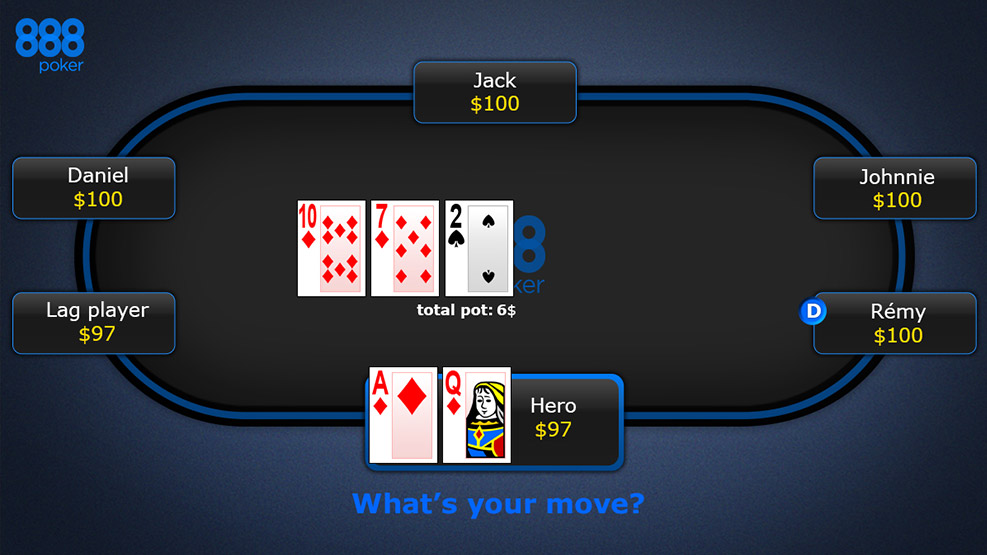
Hero opens AdQd from the small blind to 3bb and the LAG calls in the big blind. The flop comes Td 7d 2s (6bb). A c-bet would be profitable here as a semi-bluff, but the LAG would only continue with hands that connect. A check invites them to bet almost their entire range, so Hero checks, the LAG bets 4bb and Hero check-raises to 12bb.
Hero can push the idea one street further: check-call the 4bb flop bet, then check again on the Jc turn (14bb pot). The LAG reads the two checks as weakness and bets 10bb, and Hero raises to 27bb. The LAG has overextended with a range too wide to defend, so a fold is likely, and a call still leaves Hero with a flush draw, a gutshot and a roughly pot-sized bet set up for the river, to use as a bluff or a value bet depending on the card.
River bluff-to-value ratios matter too. Example: a LAG bets $100 into a $100 pot on the river, and you know they bluff about 50% of the time in this spot. You hold a bluff-catcher. Should you call or fold?
A 50/50 split looks balanced, but it's heavy over-bluffing. Your pot odds mean a call only needs to win 33% of the time, and here it wins 50%, so call with every bluff-catcher. Letting a LAG over-bluff can be the most effective counter of all, especially when they handle aggression well elsewhere. Many LAGs under-bluff certain rivers, though, so judge each spot on its own evidence.
Should You Play Loose-Aggressive Poker?
The best players don't commit to one style. They switch to loose-aggressive play when the table dynamic rewards it and tighten up just as comfortably when loose opponents are happy to hand over their chips. Build a solid tight-aggressive foundation first, then treat LAG poker as a gear to shift into when it's the most profitable option.
Key Takeaways
- A LAG plays more hands than average and plays them with bets and raises, which means bluffing often.
- Typical LAG stats: VPIP 25-35%, PFR within about five points of VPIP, 3bet 8-12%.
- Good LAGs win by exploiting opponents' mistakes, and the style needs far more skill than TAG play.
- To play LAG, open and 3bet wider, defend the big blind more, attack spots where opponents overfold, and read textures and opponents closely.
- Every LAG plays ranges too wide to defend, so they fold too much, call too much or over-bluff.
- Against good LAGs, play back and 4bet bluff with blockers. Against bad LAGs, tighten up, trap and value-bet.
- Treat loose-aggressive poker as a gear to use when the table rewards it.
