



A tight-aggressive player, or TAG, enters pots with a narrow range of strong starting hands and plays them with bets and raises instead of calls. You beat a TAG by stealing the small pots they don't want, 3-betting their opens light and folding when they put serious money in, because their big bets almost always mean a big hand.
TAG is the most common of the main playing styles you'll meet, online and live. This guide covers how to spot one, the ranges they typically play by position, how they differ from loose-aggressive players, and six adjustments that turn their discipline against them.
What Is a Tight-Aggressive (TAG) Player?
A TAG plays few hands and plays them aggressively. When they enter a pot, they want the betting lead, so they're far more likely to be the preflop open-raiser or 3-bettor than the player cold-calling. With a strong hand, they bet or raise to charge draws and build the pot, and they rarely just call.
Two neighbouring styles are easy to confuse with it:
- Rock or nit: a rock plays an even narrower range, especially from late position, and lacks the TAG's aggression.
- Tight-passive: plays a similar number of hands but calls far more often than they raise.
TAG is also the style most coaches recommend to beginners, because a tight, value-heavy range keeps difficult decisions to a minimum. That same simplicity is what makes a TAG easy to read.
How Do You Identify a Tight-Aggressive Player?
Watch two things: how many hands a player enters, and how they enter them. A TAG plays a small share of hands and almost always comes in raising.
Online: VPIP and PFR
Tracking software reduces this to two stats that most online poker players use:
- VPIP (Voluntarily Put money In Pot): the percentage of hands a player chooses to play. Most 6-max TAGs sit between 16% and 25% (25% is a loose TAG, 16% a nitty one). In full-ring games the band is roughly 10% to 18%.
- PFR (Preflop Raise): the percentage of hands a player raises preflop. It can never be higher than VPIP. In 6-max games, around 12% PFR is nitty and 20% is loose. In full ring, under 8% is nitty and over 15% is loose.
The gap between the two stats is the key read. A TAG's VPIP and PFR rarely sit more than 5 points apart, because they raise almost everything they play. A wider gap points to a tight-passive player. These bands apply to No-Limit Hold'em, and other variants of poker have their own norms, so compare a player with the rest of the table as well as with the numbers.
Live: Hands per Orbit and Showdowns
Live, you count. If a player enters only one or two hands per orbit, nearly always with a raise or a 3-bet, you're probably facing a TAG. Most of their cards go straight into the muck, which is why TAGs tend to fly under the radar at first. Confirm the read with every hand that reaches showdown: a TAG shows pocket pairs, Broadway cards and strong suited hands, almost never something like J6 offsuit.
Secondary tells can speed things up. TAGs often keep their chips in neat, even stacks, bet crisply and sit attentive and serious at the table. Other players can show the same habits, so treat them as supporting evidence only.
Keep the read open. Strong players change gears, switching style just as you think you've pinned them down, so update your assessment whenever their frequencies shift.
What Is a Typical Tight-Aggressive Poker Range?
A TAG's range widens as their position improves, because preflop hand strength depends on how many players are still to act. Individual players vary, but a typical full-ring TAG opens:
- Early position: QQ+ (QQ, KK, AA) and AK. That's just 34 poker combos, about 2.6% of all starting hands.
- Middle position: adds TT+, ATs+, KQs, QJs and JTs.
- Late position: adds AT+, all suited aces (A2s+), KJs, QJ offsuit and every pocket pair from 22 up.
Their calling range is much narrower. A typical TAG raises everything they play from early and middle position, and only flat-calls in late position, with pairs from 22 to 88 and suited aces from A2s to A9s.
Their 3-bet range is tighter still:
- Early position: KK and AA, sometimes QQ and AK.
- Middle position: JJ+ and AK.
- Late position: TT+, AK and AJs+.
None of these ranges is fixed. TAGs tighten or loosen with mood, table conditions and opponents, and a good one adds bluffs and wider 3-bets when the table allows it. The style is defined by two constants: a range tighter than most of the table, played more aggressively than most of the table.
TAG vs LAG: What's the Difference?
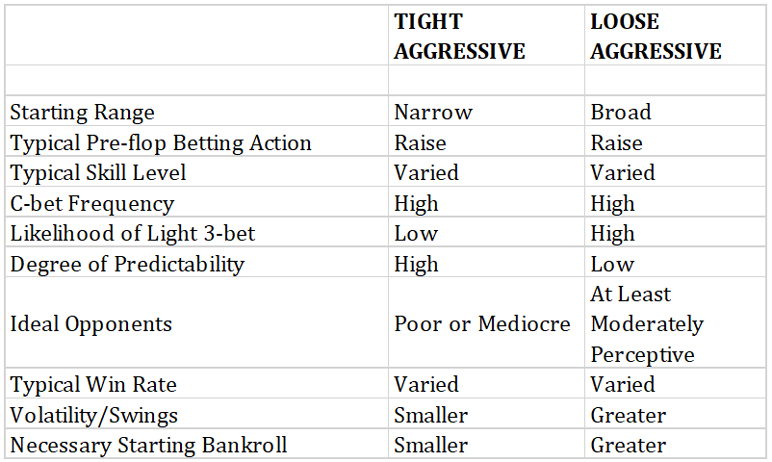
A loose-aggressive (LAG) player shares the TAG's aggression but applies it to a much wider range, raising and 3-betting light. The simplest comparison: the hands a TAG opens from late position, suited aces and other non-pair hands included, are roughly what a LAG plays from any seat, often for a raise or a 3-bet.
The frequencies show it too. A TAG typically 3-bets 4% to 5% of hands, while an average LAG 3-bets 7% to 10%. The difference comes down to risk: TAGs avoid big pots with marginal hands, and a TAG who stopped avoiding them would drift into LAG territory.
That gap shapes how you play against each one. A TAG's narrow preflop range makes it easy to judge whether a flop, turn or river helped them. A LAG's wide range makes most boards ambiguous.
Strengths and Weaknesses of the TAG Style
No style wins by itself. A skilled TAG and a skilled LAG can both beat weaker players, and a weak player loses with either. What changes is the shape of the results:
- Lower variance: fewer speculative hands mean smaller swings, so a TAG can play with a smaller bankroll.
- Strong against weak opponents: players who don't adjust keep paying off a TAG's value hands and never punish their folds.
- Predictable: a narrow range is easy to read, so observant opponents stay out of the way when a TAG bets, which caps the size of their wins.
- Leaves small pots behind: a TAG gives up many pots without a fight, and that's the opening every exploit below uses.
Good TAGs counter their own predictability by changing gears. The exploits below work best against average ones.
How Do You Exploit a Tight-Aggressive Player?
Attack the small pots a TAG doesn't want, and get out of the way when they put real money in. Their aggression usually means genuine strength, and their checks usually mean weakness. The six adjustments below apply that principle against an average TAG. Against a strong regular playing close to GTO poker, they lose much of their edge.
3-Bet Their Opens Light
TAGs respect 3-bets because they 3-bet so tightly themselves, and they're reluctant to call one or to 4-bet as a bluff. That makes preflop pressure with decent bluffing hands one of the best weapons against them.
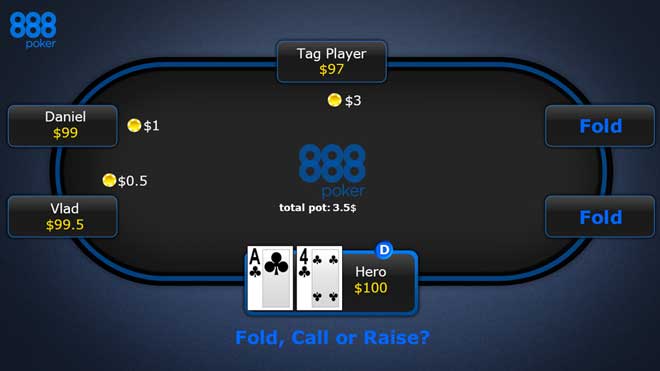
Example: 6-max No-Limit Hold'em, 100bb stacks. The TAG opens to 3bb under the gun, middle position and the cutoff fold, and you're on the button with A♣️4♣️.
Calling is too loose against a strong early-position range, and the obvious plan is to save your 3-bets for late-position opens. But re-raising an under-the-gun open represents hands like AA and KK, a far scarier story than a 3-bet against a steal. The TAG holds a hand they like but won't risk extra chips with, and your A♣️ makes it less likely they hold AA or AK.
The numbers back it up. An average TAG opens about 13% of hands and continues against a 3-bet with around 3.5%, so they fold more than 70% of the time and you take the pot without seeing a flop. If they 4-bet, you're crushed and the fold is easy. Many TAGs won't even 4-bet AK here, preferring to flat out of position.
3-betting their late-position opens works too. Your 3-bet looks less strong there, but their opening range is much weaker as well.
Give Their 3-Bets Full Credit
Swap the seats and the read changes with them. A TAG 3-bets far less often than a LAG, so when one re-raises you, a value hand is much more likely.
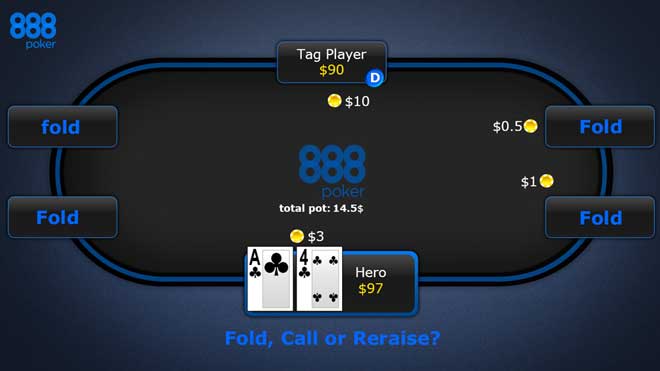
Example: 6-max, 100bb. You open to 3bb under the gun, the TAG 3-bets to 10bb on the button and the blinds fold.
In theory, 3-betting an early-position open is a strong bluff opportunity, for the reasons above. TAGs rarely take it. They're wary of re-raising a range they consider strong, so here they hold a premium hand most of the time. Unless your own hand stands up against that range, fold.
Call Wide in Position When Stacks Are Deep
TAGs get sticky with the few premium hands they play. With AA, KK or QQ they keep betting unimproved, often in growing amounts, to get full value from their narrow range. That gives a cheap call with a speculative hand big implied odds: miss and you fold to their flop bet, hit and they pay you off. Position matters, because seeing their action first gives you a clear window into their hand strength.
Example: a $1/$2 live game with $500 effective stacks. UTG+1 limps, the TAG raises to $15 from the lojack and the action folds to you in the cutoff with Q♥️T♥️.
You're well behind their range, but the call costs only 3% of your stack. If you flop two pair, trips, a flush or a straight, a typical TAG keeps betting their overpair. Call their flop bet, then either raise the turn or let them keep betting into you on the river. Miss the flop and you fold to their continuation bet.
Against a true nit, fold preflop. Their range is so narrow and so cautious that the payoff this call relies on rarely arrives, and your chips are better spent against the rest of the table.
Fold When They Bet Every Street
Some TAGs bluff more than others, and a good one should bluff reasonably often, since a tight image makes value hands easy to represent. Most don't. They play for value postflop, so when a TAG bets into you across several streets, you can make big laydowns.
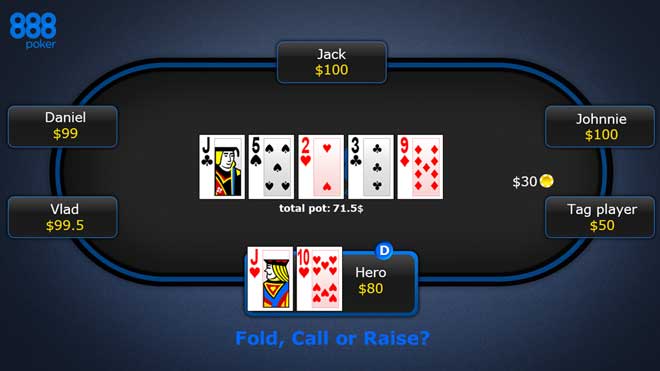
Example: 6-max, 100bb. The TAG opens to 3bb in the cutoff, you call on the button with J♥️T♥️ and the blinds fold.
Flop (7.5bb): J♣️ 5♠️ 2♥️. The TAG bets 5bb and you call.
Turn (17.5bb): 3♣️. The TAG bets 12bb and you call.
River (41.5bb): 9♦️. The TAG bets 30bb.
You still hold top pair, but think about what a TAG value-bets for three streets here. Almost no worse poker hands qualify: J8 and weaker jacks aren't strong enough, and the river has just given J9 two pair. You only win if they're bluffing, and a risk-averse TAG rarely fires three barrels as a bluff. Calling would be a hero call with little to support it, so fold.
Bet When They Check
Because a TAG plays made hands aggressively, a check is a giveaway. When the TAG was the preflop raiser, which is most of the time, a check usually means they've given up on the pot.
Example: 6-max, 100bb. The TAG opens to 3bb in the cutoff, you call on the button with J♥️9♥️ and the blinds fold.
Flop (7.5bb): T♣️ 7♠️ 2♥️. The TAG bets 5bb and you call.
Turn (17.5bb): 3♣️. The TAG checks.
The flop call is standard: you have a gutshot, an overcard and a backdoor flush draw. The turn check is the tell. Most TAGs barrel the turn with any set, overpair, two pair or top pair, so a check usually means a continuation bet that didn't get there.
Checking back to protect your gutshot is a mistake. A TAG check-raise is rare here, they'll fold often when you bet, and betting builds the pot for the times you hit an 8 on the river.
Raise Scary Flops as a Bluff, Selectively
Better TAGs know a flop can occasionally hand an opponent something big, so a well-timed raise as a bluff can make them release a premium pair.
Say the TAG raises preflop, you call, and an ace flops. They bet, and you raise, something you rarely do. With KK or QQ, many TAGs decide two pair or a set is too likely and fold, sometimes showing the hand to prove the discipline of their laydown. Some will call the flop hoping for a safe turn, so be ready to fire again.
The move fails whenever they hold the ace, and TAG ranges contain plenty of them (AK, AQ and suited aces), so keep it rare. It works best against reasonably good TAGs who are capable of folding.
Key Takeaways
- A TAG plays a narrow range of strong hands and plays them with bets and raises.
- Online, look for a VPIP of about 16% to 25% in 6-max (10% to 18% in full ring) with PFR within 5 points of it. Live, count hands per orbit and check showdowns.
- Typical opening ranges run from QQ+ and AK in early position to every pocket pair and suited ace in late position.
- A LAG plays a far wider range and 3-bets 7% to 10% of hands, against 4% to 5% for a TAG.
- 3-bet their opens light, and give their 3-bets full credit.
- Call cheaply in position with speculative hands when stacks are deep, because their overpairs keep paying.
- Fold to multi-street aggression, and bet when they check.
