



Pot odds in poker measure the relationship between the size of a bet you're facing and the size of the pot. They tell you the minimum percentage of the time you need to win a hand for calling to be profitable. Understanding pot odds is one of the most important mathematical skills in poker, because it removes guesswork from calling decisions and replaces it with a clear, repeatable framework.
NOTE: Familiarity with equity in poker is essential to getting the most out of this article. Check out our equity charts article if you need a refresher before continuing.
Why Pot Odds Matter
Most players instinctively assume a call is only correct when they expect to win more than 50% of the time. That's not true. Because there are already chips in the pot, you're always risking less than you stand to win, which means calls can be profitable even when you lose the majority of the time.
Consider a simple illustration: a stranger offers you a bet where you stake $1 against their $1,000,000, winner takes all. The catch: they win 75% of the time, you win only 25%. That's still an extraordinarily profitable bet for you, because the amount you stand to win dwarfs the amount you risk. Pot odds work on the same principle, scaled to the poker table.

Pot odds apply in four key situations:
- To determine whether you have the right price to make a +EV call right now (expressed odds).
- To calculate how much additional money you'd need to win on future streets if you don't currently have the right price (implied odds).
- On the river, to establish the minimum win rate required to make a call profitable.
- On the river, as the bettor, to determine the correct value-to-bluff ratio for your range at a given bet sizing.
How to Calculate Pot Odds
Pot odds are expressed as a percentage: the proportion of the total pot you'd be investing by calling. That percentage directly equals the minimum win rate you need for the call to be profitable.
There are two equivalent formulas. Use whichever feels more intuitive:
- Bet size ÷ (initial pot size + (2 × bet size))
- Bet size ÷ (new pot size + bet size)
Example: Your opponent bets $75 into a pot of $100 on the river.
Pot odds = $75 ÷ ($100 + (2 × $75)) = $75 ÷ $250 = 0.30 = 30%
This means you need to win at least 30% of the time for the call to show a long-term profit. It also tells you that a solver-optimal opponent at this sizing should be betting 70% value hands and 30% bluffs, leaving you indifferent between calling and folding.
Pot Odds Chart by Bet Sizing
The chart below gives you the pot equity required to call profitably at every standard bet size relative to the pot. Memorising these values eliminates mid-hand calculation and lets you focus on reading your opponent.
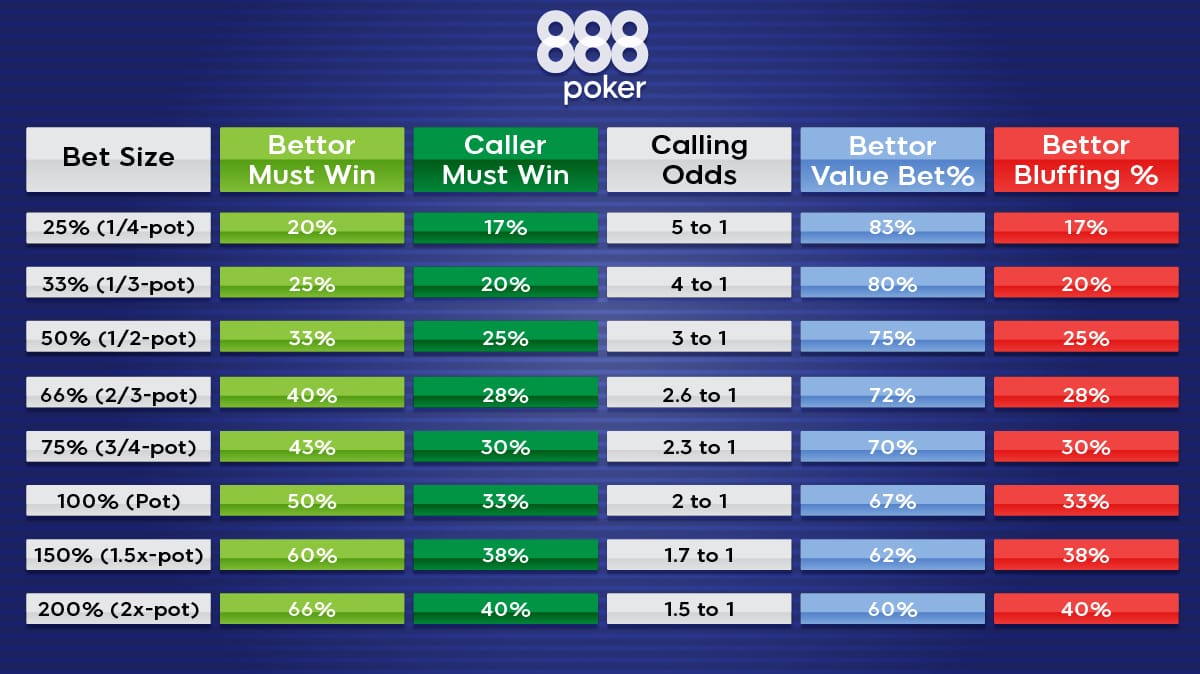
NOTE: Of all the charts in this Poker Charts series, the pot odds chart is one of the most important to know by heart. The values it encodes become automatic with practice, and once they do, your in-hand decision-making speeds up considerably.
The Rule of 2 and 4: Quick Equity Estimation
To use pot odds, you need to know your equity – that is, how often your hand will win. The Rule of 2 and 4 gives you a fast mental estimate without stopping to count every card.
- Two cards to come (on the flop): multiply your outs by 4 to get your approximate equity percentage.
- One card to come (on the turn): multiply your outs by 2.
Example: You have a flush draw on the flop (9 outs). Multiply 9 × 4 = 36% equity to hit by the river. On the turn with one card to come: 9 × 2 = 18%.
Common draw equities to know:
- Flush draw: ~19.6% (turn to river), ~35% (flop to river)
- Open-ended straight draw: ~17.4% (turn to river), ~31.5% (flop to river)
- Flush draw + open-ended straight draw: ~32.6% (turn to river), ~54.1% (flop to river)
- Gutshot straight draw: ~8.7% (turn to river), ~16.5% (flop to river)
- Two overcards: ~13% (turn to river), ~24.1% (flop to river)
Once you have your equity estimate, compare it to your pot odds percentage. If your equity exceeds your pot odds, calling is profitable. If it falls short, you need to consider implied odds or fold.
Pot Odds in Live Poker
Online, the pot size is always visible on screen. In live poker, you have to track it manually, which adds a layer of difficulty. The solution is discipline and habit, not calculation speed.
After each betting round closes, take a moment before the next card is dealt to silently update your pot size estimate. If you do this consistently, you'll always have a running total ready when a bet lands.
Just as important: don't make your thought process visible. Staring at the pot, counting chips out loud, or looking at the ceiling while you calculate signals to observant opponents that you're on a draw. Keep everything internal. The goal is to reach the same decision you'd reach online, without advertising how you got there.

Expressed Odds vs Implied Odds
Expressed odds (also called immediate odds) tell you whether the current pot offers you enough to call profitably right now, based only on what's already in the middle.
Implied odds account for additional chips you expect to win on future streets if you make your hand. They matter whenever you don't have the right expressed odds to call but believe you can recoup the difference later.
When to use each:
- Use expressed odds when facing an all-in, or when you're making the final decision before showdown. No future streets means no implied odds.
- Use implied odds when chips remain behind and your opponent is likely to pay you off if you complete your draw.
Expressed odds example: Facing a half-pot bet on the flop, you need at least 25% equity to call. A flush draw has roughly 35% equity to the river, so the call is correct on expressed odds alone – provided you're getting all the money in now.
The caution with flop calls: If you call a half-pot bet on the flop with a flush draw (36% equity) but your opponent bets again on the turn and the flush doesn't arrive, your equity has dropped to ~18% with one card to come. A second half-pot bet now gives you pot odds of 25% – you're no longer getting the right price. This is why flop calls on draws are often better framed as implied odds decisions, not expressed odds decisions.
How to Calculate Implied Odds
When you don't have the right immediate price to call, implied odds tell you how much additional money you'd need to win on a later street to make the call breakeven.
Scenario: You're on the turn with a flush draw. Equity: 18%. Pot: $100. Bet: $50.
Your pot odds are $50 ÷ $200 = 25%. Your equity (18%) falls short. You need to determine how much more you'd have to win on the river for the turn call to break even.
Using the implied odds formula:
0.18 = $50 ÷ ($50 + $100 + $50 + $X)
Solving for X: $X = $77.78
You need to win an additional $77.78 on the river (on top of the $200 already in the pot after your call) for the turn call to be breakeven.
Whether that's realistic depends on several factors:
- Position: In position, you can bet when checked to – but your opponent may not call a 40%-pot river bet on a three-flush board. Out of position, you're relying on your opponent to bet into you, or you're leading into a range that reads you as value-heavy.
- Nut advantage: If you don't have the nut flush, your opponent could have a better flush some percentage of the time, reducing your actual equity on the turn and compounding the loss on the river.
- Required bet size: $77.78 into a $200 pot is roughly a 39% bet – large enough that many opponents will fold marginal made hands. The larger the river bet you need to justify the call, the less reliable your implied odds become.
This is why draws are often best played aggressively – a raise on the flop or turn creates fold equity, which acts as a supplement to (or replacement for) implied odds that may never materialise.
Key Takeaways
- Pot odds express the minimum win rate required to make a call profitable. If your equity exceeds your pot odds, call. If it doesn't, you need implied odds or a fold.
- The formula: bet size ÷ (new pot size after call). The result is both your pot odds and the win rate you need.
- You don't need to win more than 50% of the time for a call to be correct – pot size relative to bet size is what determines profitability.
- Use the Rule of 2 and 4 for fast equity estimates: outs × 4 with two cards to come, outs × 2 with one card to come.
- Expressed odds apply when you're all-in or facing a river bet. Implied odds apply when chips remain behind.
- Implied odds are less reliable than they appear – always factor in position, nut advantage, and the bet size you'd need to extract.
- Memorise the pot odds chart. Once these percentages are automatic, you spend less mental energy on maths and more on reading the hand.
Frequently Asked Questions
What are pot odds in poker?
Pot odds are the ratio of the bet you're facing to the size of the pot. Expressed as a percentage, they tell you the minimum win rate required to make calling that bet profitable in the long run.
How do you calculate pot odds quickly?
Divide the bet size by the total pot size after your call. A $50 bet into a $100 pot creates a $200 total pot – your pot odds are $50 ÷ $200 = 25%. You need to win more than 25% of the time to call profitably.
What are good pot odds in poker?
The lower the percentage, the better your pot odds – it means you need to win less often to profit. A 20% pot odds figure (facing a small bet into a large pot) is very favourable. A 40% figure (facing an overbet) requires a strong hand or draw to justify calling.
When should you use implied odds instead of pot odds?
Use implied odds when you don't have the right expressed price to call but expect to win additional chips on a later street if you make your hand. They only apply when both players still have chips behind – never in all-in situations.
Do pot odds apply on every street?
Yes, but with different considerations. On the flop and turn, future betting rounds mean implied odds are often part of the decision. On the river, there are no further streets, so pot odds alone determine whether to call.
