



Folding in poker means giving up your hand and any claim to the pot. You should fold whenever continuing costs more than it can win you: preflop with any hand outside your position’s profitable range, and after the flop when your hand is too weak against the range your opponent is betting, given the price you’re being offered.
Once you fold, you take no further action in the hand and can’t win the pot.
Rule: When you fold, your hand is dead and your decision is final.
Etiquette rule: Fold face down and don’t show your cards to other players, especially those still involved in the hand.
Why Folding Is a Core Poker Skill
Folding is one of the most profitable decisions in poker, even though it can feel passive. Most winning players fold far more often than they play, and that discipline is what long-term profitability is built on.
Key principle: A correct fold has an EV of 0. An incorrect call is negative EV. Avoiding small negative EV calls is a major driver of long-term win rate.
Aggression (betting, raising, bluffing) creates upside, but folding controls losses. Over time, disciplined folds prevent compounding mistakes and protect your bankroll.
When in Poker Should You Be Folding Preflop?
Most hands should be folded preflop. Playing too many hands preflop creates difficult and often unprofitable post-flop situations.
A solid winning 6-max player typically plays only about 22% to 26% of hands (VPIP), which means folding roughly three out of every four hands.
Rule: If a hand isn’t profitable to open or continue with from your position, fold it.
Preflop mistakes carry forward into every street. When you start too wide, you’re more likely to face tough decisions later with weak ranges.
Some preflop folds are harder than others, because they involve hands that look playable. For the advanced spots (defending the big blind and facing 3bets, 4bets and 5bets), see our poker preflop strategy guide.
Basic Starting Hands Selection Chart
The chart below shows a 6-max opening range by position. For more charts by format and position, see our guide to poker starting hand charts.
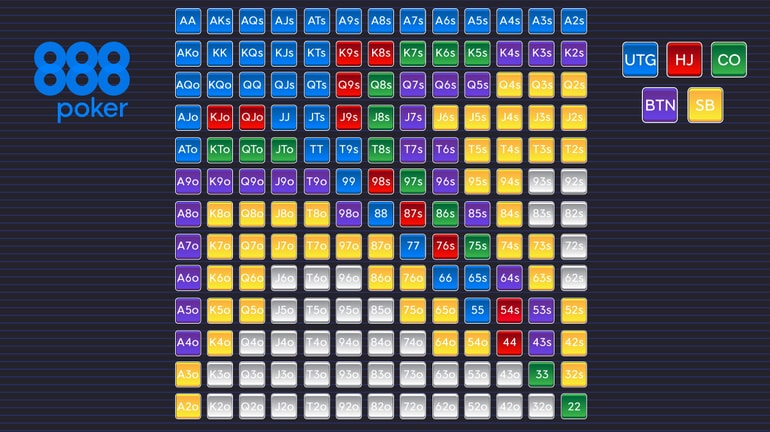
From the chart, you can see which hands to fold preflop. In general, you should be folding everything outside your position’s recommended range and everything in the white boxes.
(Note that all hands from the position before should still be included in the range for the next player position.)
When facing an open raise, folding decisions depend on the full situation, including:
- Your position
- Your opponent’s position
- Starting stack sizes
- Size of the open
- Tendencies of other players in the hand (or left to act)
- Whether you’ll be in or out of position
- The strength and style of the opponent opening
Solver work and GTO poker can help build a baseline, but discipline is still the foundation. If a hand falls outside your profitable range for that spot, fold.
Getting Opponents to Fold: Being the Aggressor
In poker, fold equity is the value you gain when your opponent folds and you win the pot immediately.
Equity normally refers to your share of the pot based on your chance to win at showdown. Fold equity lets you win without reaching showdown.
Rule: When your opponent folds, you win 100% of the pot.
For a more complete breakdown, check out the 888poker article: How Poker Equity Can Make Your Game Invincible
Post-Flop Situations: Which Poker Hands to Fold
Common Folding Scenarios and Recommended Action
- Large bet on a coordinated board, marginal made hand: fold. Your opponent has the range advantage.
- Small bet on a dry board, hand from the middle of your range: continue selectively, since the pot odds are favorable.
- River bet from a tight opponent, top pair with a weak kicker: fold. Tight players bluff too rarely to make the call pay.
- Multi-way pot under pressure, one-pair hand: fold more often, because every extra player adds value combos that beat you.
- Heads-up against an aggressive bluffer, hand from the top of your range: call or raise, because their bluff frequency is high.
Post-flop folding decisions come down to ranges, board texture and how your hand compares to the hands you can realistically have. Single-hand labels like “top pair” or “overpair” don’t settle them.
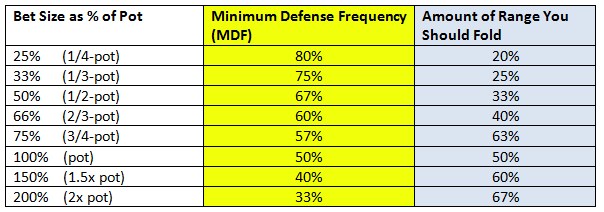
A strong baseline concept is Minimum Defense Frequency (MDF), which suggests how much of your range should continue based on the bet size you face relative to the pot.
Rule: The larger the bet, the fewer hands you should defend.
MDF is most useful against strong opponents. Against weaker opponents, exploitative folds are often more profitable than defending “correctly.”
Here’s a handy chart to use for MDF:
If you start too wide preflop, you’ll reach later streets with many weak combinations. That forces you into marginal or losing calls when facing pressure.
Post-Flop Situations: When to Fold Top Pair
Many players lose money by refusing to fold top pair. Top pair can be strong, but it can also become a clear fold when it sits near the bottom of your range in a specific spot.
Rule: If your hand is weaker than most of the hands you can realistically have in that line, it’s often a fold, even if it looks strong.
For example, imagine opening with AKo in MP1 and getting called in the CO. The flop comes K-T-7 with two spades. You bet, Villain calls. The turn is an off-suit 8. You check, Villain bets 50% pot, and you call with top pair/top kicker. The river is an off-suit 9 (K-T-7-8-9, no flush completes). You check and Villain bets 50% pot again.
Using MDF, you’re expected to continue with a stronger portion of your range. On this runout, many hands are better candidates than AK (straights, two pairs, sets and overpairs), while the number of worse hands that value-bet or bluff twice is often limited. In range terms, top pair/top kicker can become a losing call and should be folded.
From an exploitative angle, if Villain is unlikely to turn enough hands into bluffs (especially when they have showdown value), their betting range becomes weighted toward strength, which increases the EV of folding.
6 Considerations to Ask Yourself Before Folding
Use the following checklist to decide whether folding is the best option when facing a bet.
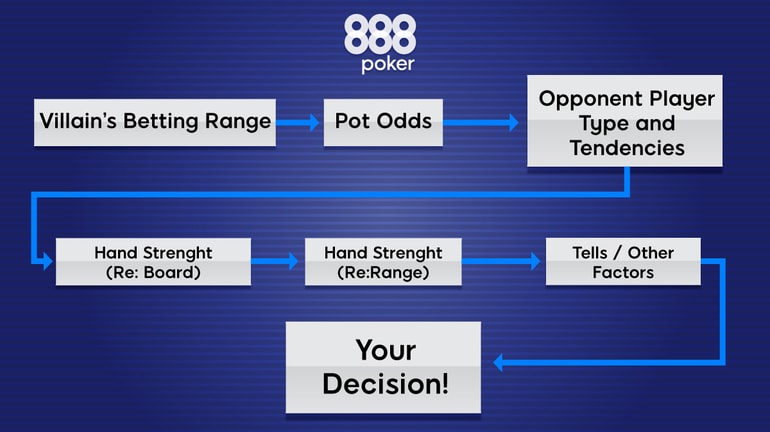
1) Villain’s Betting Range: Estimate which hands your opponent can have based on the line they took and the hands they would keep betting.
- What bluffs will my opponent bet here?
- Can my opponent be value-betting a worse hand than mine?
- How many value combos and bluff combos does my opponent have?
2) Pot Odds: Calculate what price you’re getting versus the bet size.
Rule: Against a pot-size bet, you must win about 33% of the time to call profitably. Against a half-pot bet, you must win about 25% of the time.
Note: If you’re not familiar with pot odds, our poker pot odds charts guide shows how to calculate them before you rely on calls in close spots.
3) Opponent Type and Tendencies: Decide whether to play closer to GTO baselines or exploit obvious leaks.
- Over-bluffers: call wider
- Tight players: fold more
- Unknowns: default to sound, range-based decisions
4) Hand Strength (re Board): Poker board texture changes hand value. Coordinated, monotone or paired boards increase the number of strong hands your opponent can represent and reduce your relative hand strength.
5) Hand Strength (re Range): Compare your hand to your full range. If you have many stronger hands available to call with, weaker hands should fold.
6) Tells/Other Factors: Use all available information, especially in live poker, without getting distracted after you fold.
- Multi-way pots and players left to act
- Your table image
- Opponent momentum (after a big win/loss)
- Any reliable physical or timing tells (live or online)
- In tournaments, the money bubble, where ICM pressure makes marginal calls far more costly for short and medium stacks
Frequently Asked Questions About Folding in Poker
Is folding always a bad outcome in poker?
Folding isn’t a bad outcome. It has an EV of 0 and is often the most profitable decision when calling or raising would be negative EV.
How often should you fold preflop?
Most winning players fold the majority of hands preflop, typically playing only around 22–26% of hands in 6-max games.
Should you ever fold top pair?
Top pair should be folded when it sits near the bottom of your range or when your opponent’s betting range is weighted toward stronger hands.
What is the biggest mistake players make when folding?
The biggest mistake is calling too often with marginal hands and ignoring range strength, pot odds and opponent tendencies.
Key Takeaways
- Folding ends your claim to the pot immediately.
- Most hands should be folded preflop.
- Folding prevents small negative EV calls from compounding over time.
- Fold equity wins pots without showdown.
- MDF gives a baseline for defending against different bet sizes, especially against strong opponents.
- Top pair isn’t automatically strong. Where it sits in your range decides whether it’s a call.
- Use pot odds, board texture, opponent type and range comparison before calling.
- A raise, including a bluff raise, can beat a fold when blockers, range advantage and opponent tendencies justify it.
- Always choose the action with the best expected value, not the one that feels strongest in the moment.
