

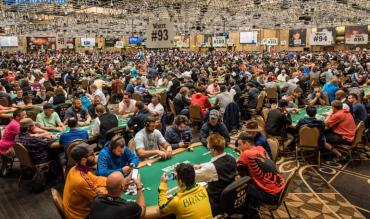

The early stages of an MTT are played tight and selectively. Stacks are deep relative to the blinds, pots are small, and the chips we stand to win are worth less than the chips we put at risk. The goal isn't to build a monster stack, it's to arrive at the ante levels with our starting stack intact and our options open.
Playing the first levels of an MTT well won't win the event on its own, but it decides how much room we have to work with once the mid and late stages arrive.
What Is the Early Stage of an MTT?
The early stage covers every level played before the antes come into force, plus the first few levels after they do. Two things define it: stacks are deep relative to the blinds, and pots stay small because there's no dead money in the middle yet.
The exact moment the antes start being taken varies with the tournament structure, so the boundary between pre-ante and post-ante play isn't fixed. What matters is recognising which side of it we're on, because the correct approach changes completely.
Why Are Chips We Win Worth Less Than Chips We Risk?
Many players describe correct poker strategy in the opening levels as similar to a cash game. There's one crucial difference, and it drives everything else.
In a cash game with a $10 buy-in, winning an opponent's stack earns us an additional $10. Win the stacks of nine other players and we're sitting behind $100 of real value. Tournament chips don't convert like that. Knock out every other player in an MTT and we might collect only 40% of the prize pool, because the remaining places are paid out too.
Each chip we add to our stack is worth less than the chip that left it. That principle has a name, ICM, and it's the reason early-stage play skews tight.
The practical consequence: getting our whole stack in on a coin flip in level two is a losing proposition. Winning increases the monetary value of our stack by a limited amount. Losing costs us the full value of our buy-in and the entire event.
How Should We Play Before the Antes Kick In?
Play on the tight side and take only clearly profitable decisions. With no antes in the pot and everyone deep, there's very little to fight over, so the reward for marginal aggression is small and the cost of being wrong is the whole tournament.
What we're looking for in this stage:
- Hands that can flop very big and win a stack, not hands that win small pots.
- Weak, overly loose opponents willing to pay us off when we do connect.
- Cheap, low-risk pots. If a hand starts threatening a large chunk of our starting stack without a strong reason, we're better off passing.
Anything that doesn't fit one of those three isn't worth the chips at this depth.
How Does Play Change Once the Antes Arrive?
Once antes are being taken, every pot is significantly larger before a card is dealt, and the blinds have grown relative to the average effective stack. The pot is now worth taking down uncontested.
The shorter our effective stack gets, the more aggressively we need to play.
Stealing the blinds becomes far more attractive than it was an hour ago, and we should be taking the good opportunities to stop our stack dwindling. We'll also get a much better price to defend our own blinds against open-raises, since the antes have improved the odds we're being laid.
At around 20-30bb we're not desperate for a double-up, so the balance shifts without flipping. We play more aggressively in genuine steal spots, and we still avoid putting the stack at risk for no reason. Passing the bubble short beats spewing the stack away chasing a double-up.
That said, we now need to stack off lighter than we would have done pre-ante. Folding sufficiently strong hands purely out of fear of missing a min-cash is a mistake. Doubling up here lets us apply real pressure once the bubble arrives.
How Should We Play Near the Bubble?
This is the hardest part of the early stage to play accurately, because the psychological pressure is at its peak. Bust now and leave with nothing, survive a little longer and take home a prize noticeably larger than the buy-in. Unsurprisingly, plenty of players start folding everything in the hope of a min-cash.
The most common leak near the bubble is passivity. The correct approach depends almost entirely on stack depth.
Hopeless Short Stack (Under 15bb)
With one of the smallest stacks left, there's little chance of folding our way into the money. We look for spots to get the chips in, ideally as the aggressor. Busting costs us less than it looks, because we weren't likely to reach the bubble by waiting.
Short to Medium Stack (15-30bb)
We're set to outlast some of the shorter stacks and reach the money even if we fold every hand, which gives us a genuine choice about how aggressively to play.
If opponents are folding too much, this is an excellent opportunity to steal hyper-aggressively and build. Running into a monster still leaves us a chance of limping into the cash. If the table isn't folding, mid-stacks may need to enter a folding war, playing hyper-conservatively until the bubble bursts and then restarting the aggression immediately.
As a mid-stack, all-in decisions against shorter stacks carry a higher expectation than all-ins against players who have us covered. Our tournament life is on the line in the second case and it isn't in the first.
Medium to Large Stack (30bb+)
Up to now we've tightened as our stack has grown. Near the bubble that flips, for three reasons:
- Opponents are playing far too tight.
- Players we have covered are even less willing to give us action.
- Getting chips in against short stacks costs us nothing in tournament life.
So we widen our stealing range and look to eliminate the hopelessly short-stacked players where the spot allows. This is the one stage where the deepest stacks at the table should be playing more aggressively than the mid-stacks.
The exception is other big stacks. Battling a deep opponent who can bust us makes little sense until after the bubble, unless we're almost certain we have the best of it. Jeopardising our tournament life while our stack is healthy enough to coast well past the money is the one mistake a chip leader can't afford here.
Should We Register Late Instead?
Some professionals deliberately register late for MTTs, and it's worth understanding why before copying it. As a general rule, late registration won't maximise our expectation for the tournament.
The logic behind it is narrow. The pre-ante stage is less valuable per hand than the post-ante stage, so skipping it raises a professional's hourly rate across a full grinding session. It doesn't improve ROI (return on investment) in any individual event, which is what most players should be optimising for.
Taking our seat from the first hand gives us the best expectation in the tournament we've actually bought into. Once the bubble bursts, the priorities shift again, and our guide to late stage tournament strategy picks up from there.
Key Takeaways
- Chips won are worth less than chips risked, so early-stage play skews tight.
- Pre-ante: play tight, chase big flops against loose opponents, avoid flips for a large chunk of the stack.
- Post-ante: loosen up steal attempts as the blinds and antes grow, and stack off lighter than before.
- Near the bubble, the correct approach is set by stack depth, not by the fear of busting.
- Under 15bb, look for spots to get in as the aggressor. At 15-30bb, attack folders and avoid the players covering us. Above 30bb, widen steals and target the short stacks.
- Late registration raises a grinder's hourly rate. It doesn't improve ROI in the event itself.
