



ABC poker is a straightforward, by-the-book way to play: you enter pots with strong starting hands, bet them for value, fold the weak ones and leave out bluffs and fancy plays. It’s the style most players learn first, and it still has a place at the right tables.
The name borrows the simplicity of the alphabet (think of the Jackson 5’s “ABC, easy as 1-2-3”). This guide covers how to play it, where it works and where it stops working.
What Is ABC Poker?
ABC poker means playing a simple, predictable game built on card strength. An ABC player waits for good hands, plays them aggressively, folds everything else and avoids tricky lines such as bluffs, slowplays and light re-raises. In practice, it sits close to a tight-aggressive style with the deception stripped out.
Most players start here after learning the rules, because it builds solid fundamentals without the risk of complex moves going wrong. As the old saying goes, you have to learn to walk before you can run, and ABC poker is the walking stage.
How Do You Play ABC Poker?
ABC poker rests on four habits: tight hand selection, playing in position, betting strong hands and skipping bluffs.
Stick to Strong Starting Hands
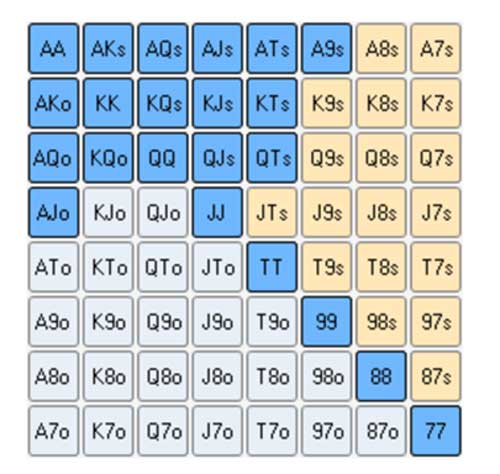
For an ABC player, tight is right. They wait for premium poker hands such as big pocket pairs and two high cards, and fold small and middle cards, weak aces and speculative hands like suited connectors. The chart below shows the kind of range an ABC player might play.
Play in Position
Position is power in poker. Acting later in a hand means you see what your opponents do before you decide, which is a big advantage in a game of incomplete information. At a nine-handed table:
- The button acts last after the flop, so it’s the best position at the table.
- The cutoff, directly to the button’s right, acts second to last and only has to worry about the button.
- The hijack, two seats to the button’s right, completes the three seats known as late position.
The seats before them make up early and middle position, as the graphic below shows.

An ABC player will play aces, kings or queens from any seat, but saves many other hands for late position, where they get the added benefit of acting last.
Bet Your Strong Hands and Protect Them
Strong hands don’t come along often, and basic poker probability shows why: you’re dealt pocket aces once every 221 hands, and any pocket pair only about 6% of the time (roughly once every 17 hands). So when an ABC player has a good hand, they bet it.
The board decides how strong that hand really is. Say you raise preflop with 10♠10♦ and the flop comes A♦K♥Q♥. Your tens are now weak against the board, so an ABC player usually checks and gives up to serious pressure. If the flop comes 10♥4♣A♣ instead, you’ve made three of a kind. Now you bet, both to get value from anyone holding an ace and to charge the club draws.
Protection starts before the flop too. ABC players raise big enough to thin the field, because a hand like pocket jacks plays far better heads-up than against three or four opponents.
Leave Out the Bluffs
Bluffing is one of the hardest skills for new players to learn, because deceiving opponents only works if you know when and how to bluff. ABC poker removes the problem. When you only play strong hands, you never have to represent a hand you don’t hold.
When Does ABC Poker Work Best?
ABC poker is simple by design, and some games reward exactly that:
- A new game or a new table: opponents need time to notice you only play good hands, so early on you can keep risk low while getting paid on your strong ones. Sitting tight also gives you time to study how everyone else plays.
- Inexperienced opponents: in home games or against casino newcomers, ABC poker keeps your own mistakes down while you benefit from theirs. Beginners rarely spot the pattern, and a player who can’t read your strategy can’t adjust to exploit it.
- Low stakes: at micro and low stakes, many players are new to the game, and big bets, loose calls and all-in shoves are common. Waiting for strong hands and betting them is a sound plan against that kind of field. Experienced regulars at higher stakes know how to beat it.
- Maniacs: against maniacs who bet and raise constantly, let them drive the action and take the small pots. When you pick up a premium hand, their aggression builds the big pot for you. Poker coach and author Ed Miller puts it simply: ABC strategy wins when opponents with marginal hands pay off your value bets while you refuse to pay off theirs.
- Short stacks: with few chips in a cash game or tournament, push-or-fold becomes the default framework in most spots, so when you move all-in, you want a strong hand behind it.
- Early tournament levels and the money bubble: as the saying goes, you can’t win a tournament in the early levels, but you can lose it, so tight ABC play fits there. On the bubble, many players tighten up to secure a cash, although observant opponents widen their ranges to steal chips from them.

When Does ABC Poker Stop Working?
ABC poker’s biggest weakness is predictability. Once opponents notice you only play strong hands, you’re effectively playing your cards face up.
A skilled player like Vivi Saliba would pick up the pattern quickly. She’d raise you more often, knowing you fold everything except strong hands, and simply fold whenever you finally bet or raise back. Good opponents either exploit you this way or avoid tangling with you at all.
Tournaments expose the same weakness. Blinds and antes rise throughout a poker tournament, so waiting for premium cards gets more expensive at every level. Without good cards, an ABC player struggles to build the stack needed to go deep, because a straightforward game has fewer ways to win pots.
Against strong competition, you need more tools. That means learning to raise more, bluff selectively and vary your lines so you’re harder to read. Studying the basics of GTO poker is a natural next step once ABC play feels comfortable.
Is ABC Poker Worth Learning?
Yes, as a foundation. ABC poker alone rarely beats tough fields, but it keeps you afloat while you learn and gives you a base to build on. Ed Miller summed up how it wins: “You make good hands, bet them, and get called. Your opponents make good hands, bet them, and you fold.”
Your game will grow as you get comfortable with bluffs and extra aggression, but the ABC approach never becomes obsolete. As Miller noted, “When the conditions are right, playing ABC is hard to beat.”
Key Takeaways
- ABC poker is straightforward, by-the-book play: strong hands, value bets and no bluffs.
- Its core habits are tight hand selection, playing in position, betting strong hands for value and protection, and skipping bluffs.
- It works best at new tables, against inexperienced players and maniacs, at low stakes and when short-stacked.
- It’s predictable, so skilled opponents can exploit it, and it struggles in tournaments as the blinds rise.
- Learn it first, then add aggression and bluffs as your game develops.
