


Few images are as instantly recognisable as Dogs Playing Poker, the series of oil paintings Cassius Marcellus Coolidge produced between 1894 and 1910. Nine of the sixteen works show anthropomorphised dogs around a card table, smoking cigars, cheating each other and staring down bluffs. Six of those nine do the heavy lifting.
This guide works through those six, painting by painting: what each scene shows, the moment Coolidge chose to freeze, and why the joke still lands for anyone who has sat at a poker table.
What Is the Dogs Playing Poker Series?
Dogs Playing Poker is the informal name for a group of Coolidge oil paintings in which dogs take on human clothes, human postures and human vices. It began with a single standalone picture in 1894. In 1903, the advertising firm Brown & Bigelow commissioned sixteen more as part of a campaign to sell cigars, and nine of those sixteen are set at a card table. The rest put the same dogs into baseball, billiards and other human pastimes.
Several compositions in the series echo the great card-playing works of art by Caravaggio, Georges de La Tour and Paul Cézanne. Coolidge borrowed the staging and supplied the punchline.
1. The Poker Game (1894)
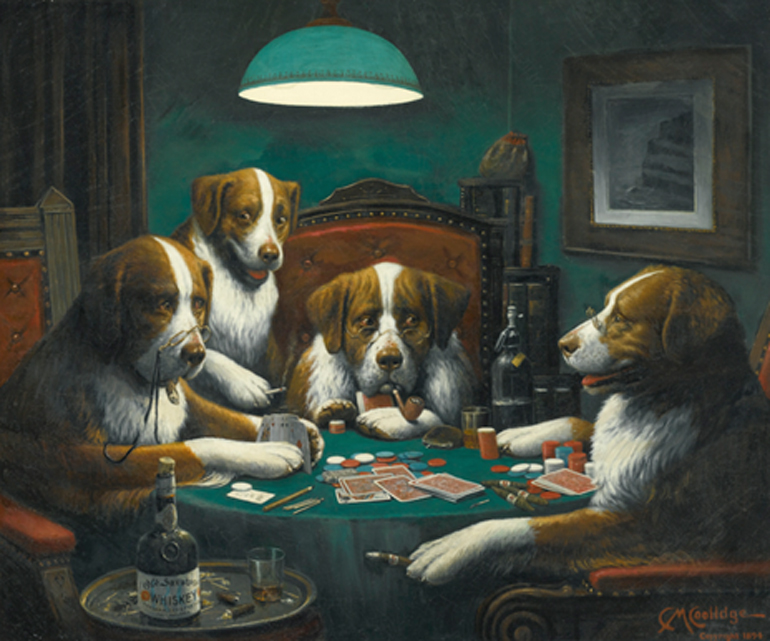
The Poker Game is the picture that started everything, painted nine years before the Brown & Bigelow commission and sold on its own. One dog slides out a heavy stack of red poker chips while the opponent across the table sits on four of a kind, waiting. Quads turn up again and again across the series, and this is where the habit starts.
Coolidge was working in an established tradition. Sir Edwin Landseer's Laying Down the Law (1840), also known as Trial by Jury, had already put a bench of dogs in a human courtroom with a poodle presiding as judge, and it's often cited as a likely influence on Coolidge's first poker picture.
The two artists are after different things:
- Landseer plays it straight. His courtroom is sombre, and his animals stay recognisably canine inside a human setting.
- Coolidge plays it for laughs. His dogs sit upright, smoke, drink whiskey and pull faces, and their expressions carry the whole joke.
That exaggeration is why the poker pictures travelled and the courtroom picture didn't. Coolidge's real subject is the men he'd watched at card tables, with the breeds chosen to fit the personalities.
2. Poker Sympathy (1903)
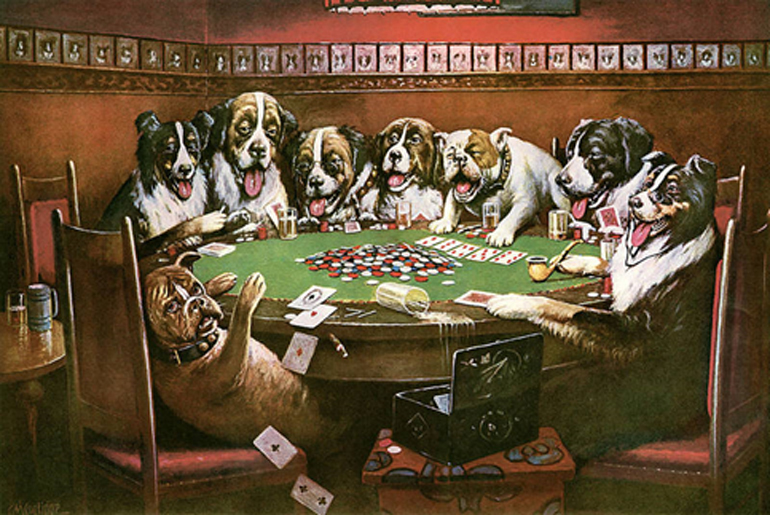
Poker Sympathy came out of the 1903 cigar commission, and it captures the worst moment in the game: the bad beat. Quad aces run into a straight flush, one of the rarest collisions in the poker hand rankings, and the losing bulldog has slumped so far into his chair that the whole table has gathered round him.
The seating and the sheer improbability of the hand give the scene a cold-deck feel, as though a group of hustlers has been working on a mark all evening. Coolidge returns to that idea more than once.
The reaction is what makes the painting land with poker players. Everyone crowds in after a big pot, offering advice, sympathy or a claim on the money, and the loser just wants the floor to open up.
3. A Friend in Need (1903)
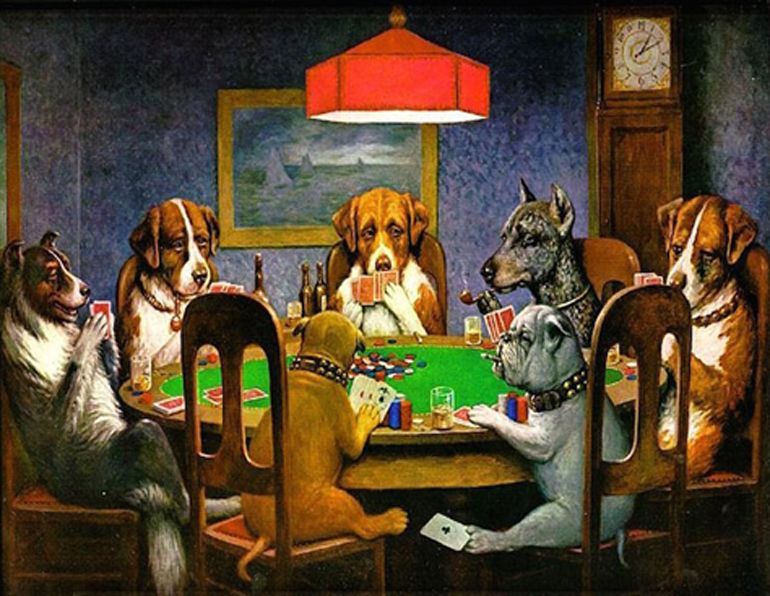
A Friend in Need is the most reproduced painting in the series, and it shows a crime in progress. A cigar-smoking bulldog is passing an ace under the table to the dog beside him, using his back paw. Coolidge puts the viewer level with the table, so the cheat is visible to us and to nobody in the painting.
That angle makes the audience complicit. The comedy of a bulldog smoking, drinking and dealing seconds with his foot takes the edge off what's actually happening, which is why the picture reads as charming instead of sordid. In a home game today, the same move would end a friendship and a seat at the table.
The casual treatment says something about the era, too. Poker in the late nineteenth century ran in back rooms with no regulation and no recourse, and cheating was part of the risk. Coolidge nods at it elsewhere in the series, in Stranger in Camp, where a newcomer turns up on the wrong side of a suspicious hand. As many Doyle Brunson stories confirm, the game was still genuinely dangerous well into the twentieth century.
Some of that stigma survives outside the poker world, where the game is still pictured as something played by gunslingers in a saloon.
4. Pinched with Four Aces (1903)
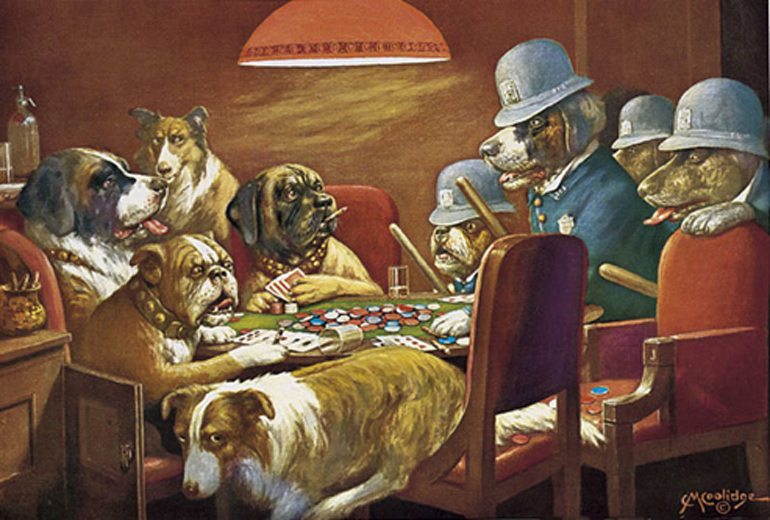
Pinched with Four Aces shows the police storming a poker game, with every officer's attention fixed on a bulldog holding four aces. Coolidge leaves the reason open. The raid could be about the game running illegally, or about the dog holding the quads.
Either way, the dog in the foreground is already halfway out of the room. It's the third painting in a row to tie the poker table to something faintly criminal, and by this point the pattern is clearly deliberate.
5. A Bold Bluff (1903)
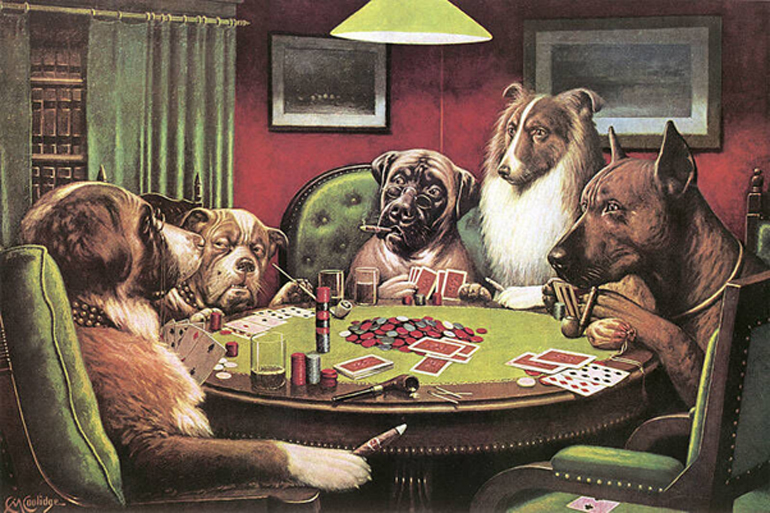
By now the recurring motifs are obvious: four of a kind, untrustworthy bulldogs, and a cigar in every mouth, which is what the sponsor was paying for. A Bold Bluff takes those motifs and builds a two-part story out of them.
A St Bernard has pushed out a tower of black and white chips holding a pair of twos. Cards are exposed around the table, so the hand has reached its final decision point, and Coolidge freezes the exact moment that makes bluffing in poker work: nobody has enough information, and everybody has to guess.
The expressions do the rest. Suspicion, irritation and open disbelief run round the table, and the bulldog's leer says he's smelled a rat. The St Bernard gives away nothing.
Coolidge originally called the painting Judge St. Bernard Stands Pat on Nothing, a title that spells out the joke the shorter one leaves hanging.
6. Waterloo (1906)
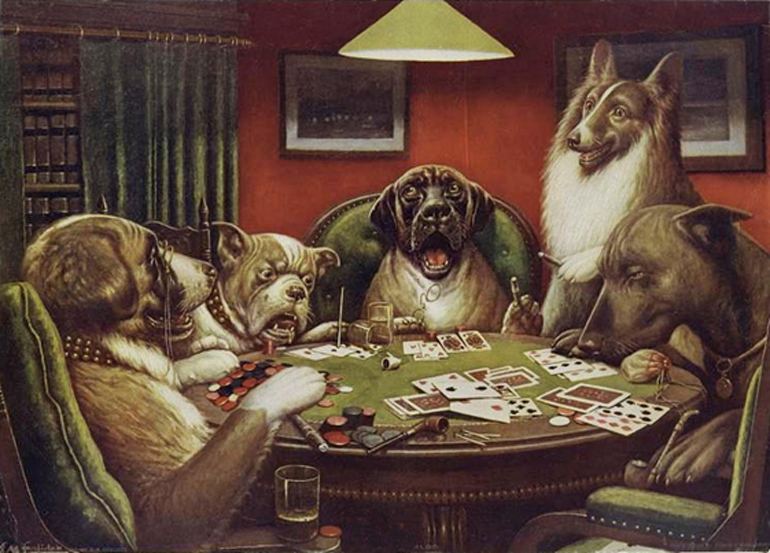
Waterloo is the payoff. Nobody called, and the St Bernard is hauling in the pot with both paws while the table erupts around him. Coolidge first titled it Judge St. Bernard Wins on a Bluff. Catalogues usually date it to 1906, though some place it inside the original 1903 commission, and two versions of the scene exist, one of which adds a poodle bringing drinks.
The title is the clever part. Waterloo carries the weight of the Napoleonic wars, dropped onto a card game between dogs, and it turns a small domestic defeat into a rout.
Being shown a bluff stings, and the painting catalogues the range of responses:
- The bulldog's fury, which is the reaction of a player who's about to lose more.
- The St Bernard's delight, earned and unbearable in equal measure.
- The collie's amazement, which is the response of somebody watching for free.
Reactions like these are readable information. Raw anger tends to travel with players who struggle in the long run, while a flatter response usually belongs to somebody who understands variance and has learned to control tilt.
Why Do the Poker Dogs Paintings Still Resonate?
The paintings work because Coolidge knew the game. He picked the handful of moments that define a session, the cooler, the cheat, the raid, the bluff and the bad beat, and he got the faces right. The way the series captures poker emotions suggests hours spent watching real tables.
The dogs give him cover. A painting of men cheating and sulking would be uncomfortable to look at, and the same scene with a bulldog in it becomes funny. That mix of comedy, recognition and mild absurdity is why prints still hang in card rooms more than a century on. For the pop-culture appearances and the prices the originals now fetch, see our Dogs Playing Poker fun facts.
Key Takeaways
- Dogs Playing Poker is a Coolidge series painted between 1894 and 1910, with nine of the sixteen commissioned works set at a card table.
- The Poker Game (1894) came first, painted before the Brown & Bigelow cigar commission of 1903.
- Four of a kind, cheating bulldogs and cigars recur across the whole series.
- A Friend in Need is the best known of the set, showing an ace passed under the table by paw.
- A Bold Bluff and Waterloo work as a pair, telling one hand from decision to showdown.
