


A poker solver is a calculator that generates Game Theory Optimal (GTO) strategies for a specific poker spot. You build a simplified version of the hand, input the hand ranges each player holds, and the software runs an iterative algorithm until neither side can improve. The output is a mathematically unexploitable strategy for that exact situation.
Solvers have changed how serious players study away from the table, and the jargon that surrounds them (game trees, decision nodes, mixed strategies, Nash equilibrium) puts plenty of beginners off before they ever open one. It doesn't need to. Here's what a solver does, what happens when you click solve, and what to do with the numbers that come back.
What Is a Poker Solver?
A poker solver is software that calculates GTO strategies for poker. You give it a scenario, and it works out how both players should play it if neither is willing to give the other an edge.
Solvers are widely used in the online game and available for purchase, though free options exist too. The system requirements for running a poker solver are modest: most modern home computers handle postflop solves without any special hardware.
One point worth setting straight early. A solver has no database of hands and no prior knowledge of poker. It's a calculator that derives strategy from scratch, every time, from the information you feed it.
What Is a GTO Strategy?
GTO stands for game theory optimal. A GTO poker strategy is one that can't be beaten in the long run by any counter-strategy, no matter how your opponent adjusts.

That sounds like the end of the conversation, but it comes with two limitations:
- GTO strategies are difficult to implement accurately. The strategies are complex, and human memory isn't.
- GTO isn't always the best available strategy. It defends against everything, so it exploits nothing. If an opponent folds far too often, GTO won't punish that mistake as hard as a targeted adjustment would.
Even so, studying with a solver is one of the fastest ways to understand why strong strategies look the way they do.
How Do You Use a Poker Solver?
The exact steps vary between packages, but the process is the same in all of them:
- Build a game tree. Define the actions available at every point in the hand.
- Input ranges for both players.
- Run the solve and explore the results.
Getting your first solve running is straightforward. The skill sits in the choices around it: building logical trees, selecting realistic ranges, and reading the output in a way that transfers to real hands.
Experienced users often set up scripting, a feature that queues a list of related solves so the computer can work through them unattended, usually overnight.
What Is a Game Tree?
A game tree is a simplified map of every action that can occur in a hand. The points where a player has a decision to make are called decision nodes.
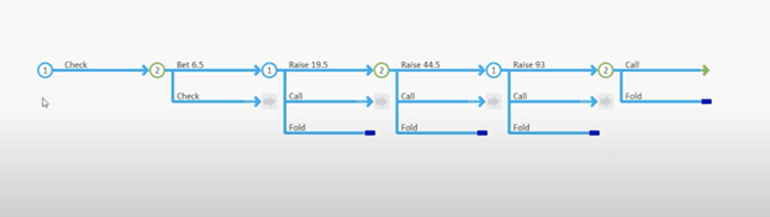
Most solvers include a game tree builder, which speeds this up by letting you set bet sizes, stack depths and available actions from a menu instead of constructing everything by hand.
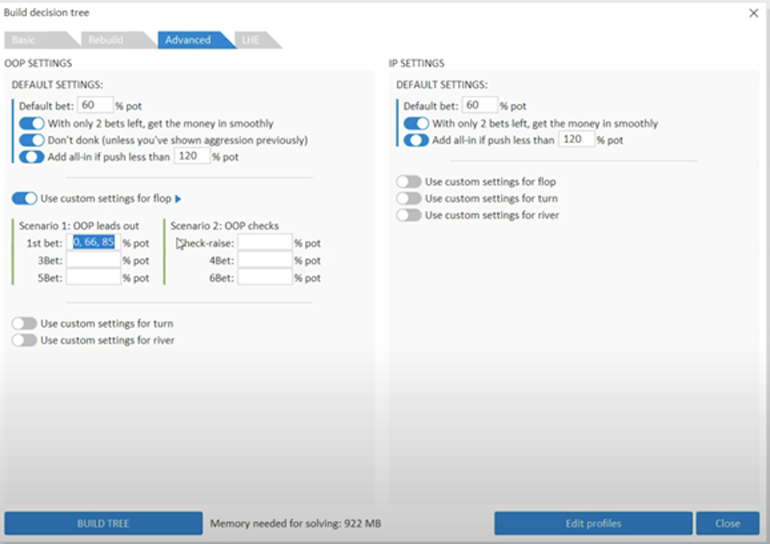
The quality of the tree decides the quality of the answer. A tree with unrealistic bet sizes produces a solution that has little to do with the games you actually play, and because a postflop solve runs on one specific poker board, the flop you choose shapes the result as much as the sizings do.
So why simplify at all? Because a tree containing every legal bet size at every node would be astronomically large. Solving it would take an unrealistic amount of time, which makes simplification a requirement instead of a compromise.
How Do You Select Ranges for the Solve?
Once the tree exists, you tell the solver which hands each player can hold. Solvers provide a hole-card grid where you click hands into each player's range.
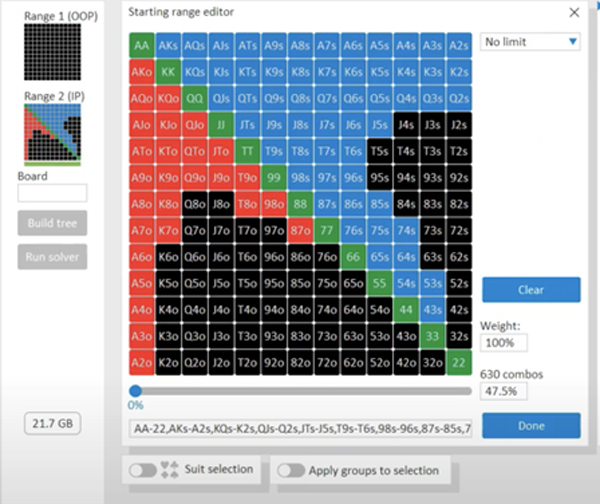
There's no single correct answer here, though some approaches are stronger than others. Three are common:
- Using experience. Estimating each player's range from what you've seen players show down in similar spots. It's quick, and your estimates can be badly off.
- Using solved GTO ranges. Importing preflop ranges produced in a separate preflop solve. This is the standard approach for theory work.
- Using population ranges. Mining a large hand database to see what opponents have actually turned over in that situation. Arguably the most useful method, and the hardest, because it needs a very large sample to be accurate.
How Does the Solving Algorithm Work?
The solving algorithm is iterative. It repeats the same process thousands of times, refining both strategies a little on each pass.

Under the hood, it runs like this:
- The solver knows nothing about poker, so it assigns both players an arbitrary starting strategy.
- It adjusts player 1's strategy slightly, so that it exploits the weaknesses in player 2's strategy and gains expected value.
- It then adjusts player 2's strategy slightly, exploiting the weaknesses that player 1's new strategy has created.
- It repeats the adjustment for player 1, then player 2, over and over.
- Each pass leaves both strategies harder to exploit, until neither player can gain anything by changing. That end point is a Nash equilibrium, and the solve is complete.
In practice, running all the way to a perfect equilibrium takes far too long, so solvers let you set an accuracy threshold and stop just short of it. The results are then fractionally inaccurate, by a margin small enough to be irrelevant to a human player, and the solve finishes in a fraction of the time.
How Do You Read Solver Output?
Solver output is dense, and no human can apply it directly at the table. The main obstacle is that GTO strategies lean heavily on mixed strategies, where a single hand is played more than one way.
A hand might be raised 17% of the time, called 63% and folded 20%. That's a valid instruction for a computer, and an impossible one to execute precisely in a live session.
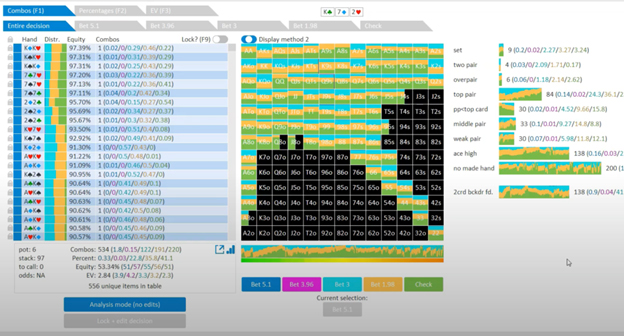
Two approaches make the output usable:
- Study the concepts. Use solves to learn why the solver bets small on one board and large on another, then take the principle to the table instead of the percentages.
- Simplify deliberately. Round the mixes into clean rules you can actually follow, accepting a tiny loss in accuracy for a large gain in usability.
Can You Solve Preflop Ranges?
Yes. Solvers can generate GTO preflop ranges, and a preflop solve needs no input ranges, since the ranges are the thing you're solving for.
The catch is cost. Preflop solves are far more computationally intensive than postflop ones and demand significantly more powerful hardware. A postflop solve runs on an average home computer, while a preflop solve usually needs a high-specification custom machine or rented cloud time.

Because of that, most players never run one. They buy a set of pre-solved preflop ranges instead, and complete sets can be found online for free. Those ranges improve your own preflop play and can be loaded straight into your solver as the starting point for postflop work.
What Are Pre-Solved GTO Solutions?
Some companies sell the finished output directly. You get access to a library of completed solves without building trees or leaving a computer running overnight.
- The upside is instant access to a large volume of GTO solutions.
- The downside is a recurring subscription fee, which usually works out more expensive over time than running your own solves.
The trade is time against money. Your own solves are cheaper and slower, pre-solved libraries are faster and pricier.
Are Neural Networks the Same as Poker Solvers?
No, though the two get mentioned in the same breath because they chase the same target: GTO solutions for poker scenarios.
- A neural network uses machine learning. It plays trillions of poker hands against itself, improving as it goes, and stores what it learns for later reference. It teaches itself the game through trial and error.
- A solver stores nothing. It meets each scenario cold and runs the iterative algorithm from scratch.
A solver doesn't know how to play poker in any meaningful sense. Feed it the right information, and it will still hand you equilibrium strategies.
How to Get Started with a Poker Solver
Prices vary dramatically, even between products running near-identical algorithms underneath. Free solvers exist that perform about as well as commercial packages carrying three-figure or four-figure price tags, so it pays to shop around and test before committing.
If the concepts above still feel abstract, that's normal, and reading more theory won't fix it. Build a simple tree, load two ranges, run one solve and click through the output. Twenty minutes with a live solve teaches more than an afternoon of definitions, and any unfamiliar poker terms you hit along the way are quick enough to look up as you go.
Key Takeaways
- A poker solver calculates GTO strategies for a specific spot. It has no built-in poker knowledge and works only from what you give it.
- A GTO strategy can't be exploited, and it doesn't exploit anyone either.
- Every solve needs two inputs: a game tree (the available actions) and hand ranges for both players.
- The algorithm is iterative. It adjusts each player's strategy in turn until neither can improve, which is the Nash equilibrium.
- Output arrives as mixed strategies and needs simplifying before it's usable at the table.
- Postflop solves run on a normal computer. Preflop solves need serious hardware, so most players buy or download pre-solved ranges.
- Neural networks learn by playing; solvers calculate from scratch.
