


Chinese Poker is a 13-card poker variant played without betting, bluffing or community cards. Each player splits their 13 cards into three hands, two of five cards and one of three, and compares each hand against every opponent's. Every hand you win collects one unit, so a second-best holding still scores.
Know your poker hand rankings and you can sit down and play competently on day one. The skill lives entirely in how you arrange the cards, which is why the game has a following among professionals and beginners alike, often as a side game between tournament levels.
What Is Chinese Poker?
Chinese Poker is a hand-setting game for two to four players, using a standard 52-card deck. There are no betting rounds, no draws and no community cards. The entire game is the decision of how to divide your 13 cards into three rows, and the entire skill is making that decision better than the players sitting with you.
It's played for units instead of chips. A unit is a fixed value the table agrees on before the first hand, and scores are tracked on paper and settled once the session ends. That makes it one of the simplest types of poker games to run at a kitchen table, because all you need is a deck and something to write on.
With four players, all 52 cards are dealt, which is why four is the maximum. Three-handed and heads-up games are common and work in exactly the same way.
Chinese Poker Rules
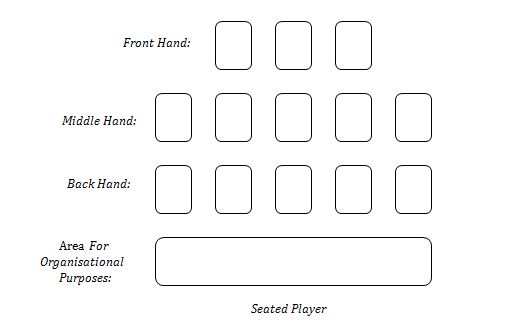
Every player receives 13 cards and splits them into three hands. This is called setting, and the three hands have fixed names and fixed requirements:
- The back: five cards, and it must be your strongest hand.
- The middle: five cards, and it must rank below the back.
- The front: three cards, and it must be the weakest of the three. Straights and flushes don't count in a three-card hand.
Three-of-a-kind is a legal front hand, but it still has to sit in the front, and your middle and back have to outrank it. Get that order wrong and you've fouled.
Fouling (Mis-Setting)
A fouled hand is one where the three rows aren't in descending order of strength. The penalty is the same as losing all three hands to every opponent, so three units each. A player who fouls doesn't pay anyone who has already surrendered.
Agree beforehand whether a fouled hand still gets played and scored normally after the penalty, or whether it's simply forfeited and the three-unit payment settles it.
Surrendering
Surrendering is optional, though most tables use it. A player who doesn't like their 13 cards can pay a fixed amount and sit the hand out. The figure is usually set between what they'd lose for dropping two hands and what they'd lose for being swept, so somewhere around two to two and a half units. A player who surrenders also avoids paying royalties for that round.
Winning Outright
Some 13-card holdings win the hand on sight. If you can set three flushes or three straights across your rows, you scoop three units from every player who hasn't surrendered, whatever anyone else is holding. These holdings are called naturals, and they're covered in the royalties section below.
How Do You Play a Hand of Chinese Poker?
A hand runs through six steps, and the dealer button moves one seat to the left after each one.
- Dealing: the dealer gives 13 cards to each player, starting with the player to their immediate left.
- Setting: each player arranges their cards into the back, middle and front hands.
- Placing: players lay their three hands face down in a row in front of them. The back sits closest to the player, the middle in front of it, and the three-card front furthest away.
- Declaring: starting to the left of the dealer, each player announces whether they're playing their hand. This is the moment to surrender, if you're using that rule.
- Announcing royalties: players call their royalties in the same order, before any cards are turned over.
- Revealing and scoring: hands are turned face up, the rows are compared, and units are tallied.
What Are the Chinese Poker Hands?
Chinese Poker uses the standard poker hand rankings, so the two five-card rows are read exactly as they would be in Hold'em or Omaha. From strongest to weakest:
- Royal Flush: ace down to ten, all in one suit. A♠️K♠️Q♠️J♠️10♠️
- Straight Flush: any five consecutive cards in one suit. 8♥️7♥️6♥️5♥️4♥️
- Four of a Kind: all four cards of one rank, plus any fifth card. 4♠️4♥️4♦️4♣️A♠️
- Full House: three cards of one rank with a pair of another. A♠️A♥️A♦️J♠️J♥️
- Flush: any five cards of the same suit, not in sequence. A♦️J♦️8♦️4♦️2♦️
- Straight: five consecutive cards in mixed suits. 8♠️7♥️6♦️5♠️4♣️
- Three of a Kind: three cards of one rank, plus two unmatched cards. 5♠️5♥️5♦️A♠️K♥️
- Two Pair: two pairs of different ranks, plus any fifth card. A♠️A♥️J♠️J♦️2♣️
- One Pair: two cards of the same rank, plus three unmatched cards. A♠️A♥️7♦️4♠️2♣️
- High Card: no pair, straight or flush, so the highest card decides. A♠️Q♥️9♦️6♠️3♣️
The front hand is the exception. With only three cards, and with straights and flushes discounted, it can only ever be three-of-a-kind, one pair with a kicker, or a high-card hand. That short ceiling is what makes the front row worth thinking about carefully.
How Many Ways Can You Set a Chinese Poker Hand?
There are 72,072 legal ways to divide 13 cards into a three-card front, a five-card middle and a five-card back. You'll never work through them at the table, and you don't need to. Most hands sort themselves into two or three serious candidates once you've fixed the back row, and the real decision is which marginal card you sacrifice to keep the front competitive.
How Does Chinese Poker Scoring Work?
Scoring happens row by row. Your back hand is compared against every opponent's back hand, your middle against every middle, your front against every front. You collect one unit from each player you beat in each row and pay one unit to each player who beats you.
Take four players and look only at the back hands:
- Player 1 has the strongest back hand and beats all three opponents: +3 units
- Player 2 loses to Player 1 but beats Players 3 and 4: +1 unit
- Player 3 loses to Players 1 and 2 but beats Player 4: -1 unit
- Player 4 loses to everyone: -3 units
The same process then runs separately for the middle hands and the front hands. Because every row is settled independently, a player with the second-best hand in a row still collects from everyone below them.
The 1-6 and 2-4 Methods
On top of the row-by-row units, most tables award a bonus for winning multiple hands against the same opponent. There are two standard methods, and you need to agree which one you're using before the first deal:
- 1-6 method: only a clean sweep pays a bonus. Win all three rows and you take three extra units from that player, for six in total. Win two rows out of three and you take one unit, with no bonus.
- 2-4 method: winning the majority pays a bonus. Take two of three rows and you collect one extra unit for a total of two. Sweep all three and you collect four.
The names come from those totals, which makes them easy to remember once you've seen the arithmetic.
Keeping Score
With three or four players, the cleanest method is to track each pairing separately instead of running one combined total. Start with the player to the dealer's left and compare their hands against each player to their left in turn, then move on to the next player and compare only against opponents not yet tallied. The final comparison is between the dealer and the player on their immediate right.
A score sheet is one column per opponent and one row per hand. Player 1's sheet after two hands might read:
- Hand 1: +1 against Player 2, +3 against Player 3, +1 against Player 4, for +5 on the hand.
- Hand 2: -1 against Player 2, +1 against Player 3, +1 against Player 4, for +1 on the hand.
- Running totals: level with Player 2, +4 against Player 3, +2 against Player 4, and +6 overall.
Tracking it this way has a second advantage. Two specific players can agree a different unit value between themselves, say a unit worth five times the table standard, without it affecting anybody else's scoring. That's a feature you won't find in most other poker formats.
What Are Royalties in Chinese Poker?
Royalties are bonus units awarded for particularly strong holdings, and they have to be declared before any cards are revealed. The values below are the common baseline, and every table is free to adjust them before play begins. There are two types.
Hand-Ranking Royalties
These are fixed amounts paid for making a specific hand in a specific row. Position matters as much as strength, because a holding that's unremarkable in the back can be exceptional in the front.
- Front hand: three-of-a-kind pays 3 units. Nothing else in a three-card row qualifies.
- Middle hand: full house 2 units, four-of-a-kind 8, straight flush 10, royal flush 20.
- Back hand: four-of-a-kind 4 units, straight flush 5, royal flush 10. A full house in the back pays nothing, because it's the row where you'd expect to find one.
Decide in advance whether every qualifying player collects a royalty, or only the player holding the best one in that row. Under the second rule, a straight flush in the back collects nothing if another player has a royal flush in theirs.
Naturals
A natural is a royalty based on all 13 cards falling into a special category. Naturals are awarded before anyone can surrender, and the player holding one doesn't set or play their hand. They simply collect. The remaining players can carry on with the hand if they want to.
- Six Pairs: 3 units
- Three Straights: 3 units
- Three Flushes: 3 units
- No Broadway Cards (optional): 3 units
- Dragon, one card of every rank from Ace to King: 13 units
Chinese Poker Variations
Two variants dominate, and both are played face up.
Open-Face Chinese Poker
In Open-Face Chinese Poker, you don't see your 13 cards at the start. Each player receives five cards, places them face up into their three rows, and then draws one card at a time until all 13 are placed. Once a card is down, it can't be moved.
That single change transforms the game. Because you're committing cards before you know what's coming, fouling is far more common than in the classic version, and a foul costs six units to every opponent who hasn't also fouled. Surrendering costs two units per opponent. Scoring works as it does in regular Chinese Poker, with the 1-6 method as the standard.
Royalties are worth far more in Open-Face, because reaching a premium hand without knowing your 13 cards is much harder. They also can't be announced in advance, so they're calculated during scoring.
Fantasy Land
Fantasy Land is an optional add-on to Open-Face that almost everyone plays. Make a pair of Queens or better in your front hand without fouling and you enter it. On the next hand you receive all 13 cards at once and set them in private, revealing only after the other players have finished, which is an enormous advantage.
To stay in Fantasy Land for another hand, you need one of the following:
- Three-of-a-kind in the front
- A full house or better in the middle
- Quads or better in the back
Pineapple
Pineapple follows Open-Face rules with one change to the draw. After the opening five cards, players receive three cards per turn, place two and discard the third face down. Nobody sees the discard, so throwing away the card you know an opponent needs is a legitimate weapon.
The format runs five turns per player, which speeds the game up considerably, and it caps at three players because of the discard pile. Fantasy Land works the same way, except that players receive 14 cards and discard one while setting.
Other Variations
- 2-7 Lowball: the middle row is played as a 2-7 low hand.
- Criss Cross: a heads-up version where each player is dealt two separate 13-card hands, played against the corresponding hand opposite. Cards can't be swapped between your two hands. It gets more hands played per shuffle.
- The Wheel Straight: A-2-3-4-5 is promoted to the second-best straight, sitting directly below A-K-Q-J-10 and above K-Q-J-10-9.
Chinese Poker Strategy and Tips
- Never foul: it's the most expensive error in the game and it's entirely avoidable in the classic version. Count your rows twice before you place them.
- Don't treat the front as a dumping ground: the three-card row is worth a third of the units on offer every round, and it's the row where royalties pay best. Weakening it to squeeze a marginal upgrade into the middle usually costs more than it gains.
- Track the exposed cards in Open-Face: every card on the table is a card removed from your draws. Knowing that two of your outs are already showing changes whether you commit to a draw or play it safe.
- Read your opponents in Open-Face and Pineapple: against a player who chases every long shot, set conservatively and let them foul. Against a careful opponent, you'll need to reach for a royalty to win the exchange.
- Respect the variance: set your unit value lower than feels necessary. A single natural or a royal flush in the back can swing a session no matter how well you've set your own hands.
Where Can You Play Chinese Poker Online?
Chinese Poker has never approached the popularity of Hold'em or Omaha, but it keeps a committed following, and it's usually played three or four-handed where it does run online.
For practice away from the tables, the free tool at Primedope deals you 13 cards, lets you set them yourself, and then shows you how the hand could have been arranged more effectively. It's a fast way to build a feel for the trade-offs between rows.
What to Agree Before You Play
Chinese Poker carries more optional rules than most poker formats, and almost all of them affect scoring. Settle these seven points before the first deal:
- Which bonus method are you using, 1-6 or 2-4?
- What does a surrender cost?
- Does a fouled hand still get played and scored after the penalty, or is it forfeited?
- Are any two players using a different unit value between themselves?
- Are you including the optional No Broadway Cards natural?
- What is each royalty worth, and does every qualifying player collect, or only the best one in the row?
- If you're playing Open-Face or Pineapple, is Fantasy Land in?
Key Takeaways
- Chinese Poker deals 13 cards to each player, split into a five-card back, a five-card middle and a three-card front.
- The back must be the strongest hand and the front the weakest. Breaking that order is a foul and costs three units to every opponent.
- Straights and flushes don't count in the three-card front hand, so it tops out at three-of-a-kind.
- Rows are compared individually, one unit per row won, so a second-best hand still scores.
- Sweeping all three rows pays a bonus, six units in total under the 1-6 method and four under the 2-4 method.
- Royalties are declared before hands are revealed, pay most in the front row, and are far larger in Open-Face.
- Naturals are settled before anyone can surrender, and a Dragon is worth 13 units.
- Every optional rule affects scoring, so agree the full list at the table before the first deal.
