


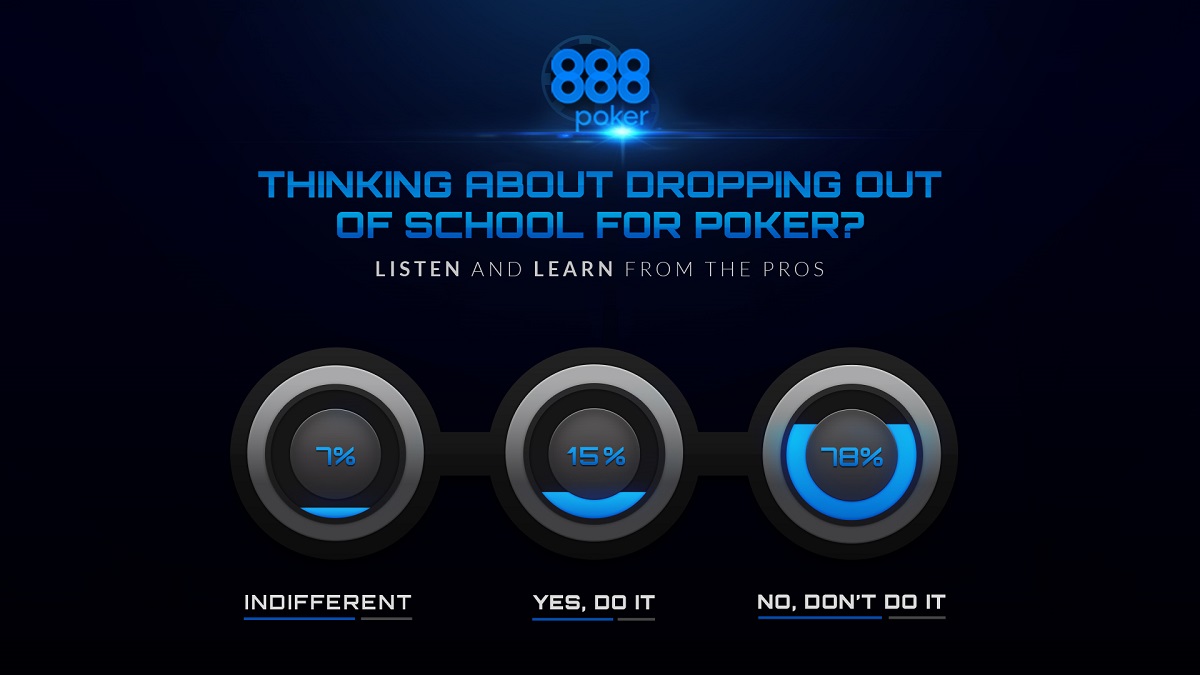
The players who've already made that call come down heavily on one side: finish school first. Of the 45 poker players polled for this piece, 35 (78%) said dropping out to pursue poker professionally was a bad idea, seven backed it and three were undecided. Even most of those who did drop out advise keeping the degree.
Thinking of dropping out of school to chase the dream of professional poker? The poker world is full of stories about people who did exactly that and struck it big. As in tournament poker, though, for every one of those there are hundreds who failed quietly, and you rarely hear about them.
As someone who dropped out of law school and later abandoned a career in education to pursue poker (to be fair, I do have a Bachelor of Arts degree from the University of Wisconsin–Madison), I often wonder what my life would look like had I chosen a different path. It worked out for me, in an unusual fusion of player and writer: I make a living in the industry, play on the side, and won a World Series of Poker gold bracelet in 2013. That's the exception, and the players below are unanimous that it shouldn't be the plan.
Has Poker Got Harder Since the Boom?
Yes, and by a distance. When I played at a New Orleans casino in 2007, the question wasn't whether I'd win but how much. Each table had maybe one or two players who knew what they were doing, and the rest were there to donate. Fields today are educated, and you'd be lucky to find a single weak spot at the table.
Poker used to be a hard way to make an easy living. It's just hard all around now.
Mike “MeleaB” Brooks, an online player, put numbers on the decline when the poll was run in 2016:
Six years ago, it would have been worth considering if you had a flair for the game (good number sense/innate problem solver.) Today, with those same skills, it is a definite no. Back in 2010, with those traits and hard work, $200k+ per year would be quite feasible, and actually relatively easy for some. Plus, there was little indication to believe there would be an end to that type of favourable lifestyle.
Those players today, even allowing for an average increase in ability would make close to 25% of that salary, with good reason to believe things could get worse.
There is now virtually no good reason at all (from what I can see) to drop out of school, or quit a decent job. If someone does happen to possess the potential to belong in the now elite group of players who earn a healthy salary, then they should play part-time until that belief is reinforced by long-term results and their studies are complete.
The other structural change is study. Jake Balsiger, third in the 2012 WSOP Main Event, saw it coming a decade before it became standard:
Ten years ago I wouldn't be fully opposed to people dropping out. I think there is real value to trying to make a dream really work. Even if it fails, there is still a lot of life left to be lived. In the present day environment, though, where we grow closer and closer to AI every day, I think it would be a huge mistake.
Online will no longer be possible, and even live games will likely be crippled. While people won't be allowed to use the software at the table, semi-memorising decent hand ranges and when/how much to c-bet is, I believe, all it would take for the hourly of professionals to plummet and make it no longer a viable career.
That prediction has largely played out. Solver work is now baseline preparation instead of an edge, a serious player is expected to arrive with poker GTO fundamentals already in place, and online rooms invest heavily in detecting real-time assistance. The average opponent is far better prepared than the 2016 average opponent, which squeezes the win rate of everyone below the top tier.
Jason Brin, the 2015 WPT Choctaw champion, framed the consequence bluntly:
Poker professional careers are non-existent. Without either sponsorship, a backing deal, family with deep pockets, or without that once-in-a-lifetime cash, they are non-existent. Professional careers are ones that build wealth, ones that you can walk away from and live off your past sweat.
Stay in school. Nothing better than blanking a tourney and not giving a shit. The poker world is shifting to semi-pros whose main source of income is not from poker.
What Did 45 Poker Players Say About Dropping Out?
I put the question to the poker community and received dozens of responses from recognised and respected names, both for and against. The sample was small, but the split was decisive: 35 of the 45 respondents (78%) said dropping out of school to pursue poker professionally was unwise, seven (15%) supported the decision and three (7%) were indifferent.
The refusals were the most emphatic answers of the lot. Kyle “KPR16” Ray, an online poker legend, walked away as a senior in 2009:
My advice to people is, do not, under any circumstances, drop out of school for poker. I left as a senior in 2009 for a BA in Marketing. I consider myself one of the best case outcomes, and I regret it. I'm enjoying returning to school now, with a bit more maturity, but I still wish I had completed it while I was there the first time.
I would add that poker has taught me quite a bit, and I will always be grateful for that. Especially when it comes to investing, as I doubt there's a better training ground than poker when dealing with risk and uncertainty. But yeah, stay in school is still great advice.
Scott Davies, the 2014 WSOP Asia-Pacific Main Event champion, was blunter still:
Please don't offer any words of encouragement to those dropping out of school to play poker. While a few undoubtedly will make it, the majority are delusional kids about to make a decision that could have catastrophic consequences for the rest of their life.
I'd tell anyone thinking of doing this to finish school; poker will always be there.
Josh Brikis, a former pro with more than $1.5 million in tournament earnings, took the same line on the outliers:
This is one of those, even if you are lucky enough to succeed for a short period of time, it's still 100% the wrong decision.
Jesse Sylvia, runner-up in the 2012 WSOP Main Event and a World Poker Tour Borgata Poker Open champion, gave the shortest answer received:
Just write “DONT DO IT” in the largest sized font you're allowed.
What Do You Give Up by Leaving School?
Optionality, mostly. A degree or a trade keeps doors open that poker closes quietly over a decade. Tom Schneider, the 2007 WSOP Player of the Year, made the long-horizon case:
Life is about options. Playing poker only narrows your world too much. Making $50,000 without working too hard seems awesome until 20 years from now when your friends are making $200,000 or more.
Poker is a battle against yourself and all of the things your brain tells you when things aren't going so well. There are less than 1000 people in the world that have made a consistent decent living over 10 years or more. Keep all your options open to maximise your income.
The second cost is developmental. Alex “Assassinato” Fitzgerald, an online player, coach and author, is grateful for the game and still wishes he'd studied:
Poker has been the greatest and best journey I could have ever hoped for. I have learned discipline and resourcefulness from the game. I've seen the world. I've met people from all creeds and professions. I've opened my mind. That being said, I very much wish I got a formal education and learned discipline and study with other people my age.
Growing up in casinos, airports, and grind holes is not conducive to maturity and happiness. I am the exception, not the rule. Don't quit your day job. Be an apprentice, go to trade school, go to university, whatever, just learn.
Get a real skill. Poker will always be around.
The third cost is enjoyment. William Sturiano, a mid-stakes grinder, points out what changes when the game becomes the income:
You can play poker and go to school. Finish college, build a bankroll and have fun. When you play poker as your only means of income, it brings in an element of pressure to poker, as opposed to poker being an escape from the pressures of life.
I know “professional poker” seems glamorous, but the reality is you become a squirrel who has to leave his den, gather his nuts and try to evade all the predators that are trying to eat you.
Would I change the decision I made to walk from my career of 25 years? No, but I'm in my 50s and have no dependents.
Is There Ever a Case for Dropping Out?
A minority said yes, and every one of them attached conditions. Matt Vengrin, a long-time tournament pro, left a semester short of his degree and doesn't regret it:
I woke up one morning and asked myself if I was happy at college. The answer came back a resounding “no,” and I decided to drop out. I had about one semester left to get my BA in Psychology. I don't regret it one bit. For the past 11 years I have been doing what I want when I want, and travelling the world. I have met so many cool people along the way, and I wouldn't have it any other way.
That being said, it is not an easy profession. It has its ups and downs.
One of the things I've learned in life is that whoever works the hardest will be the most successful. It's really that simple. Everyone wants to be the best, but not everyone is willing to put the work in. The other piece of advice I will give is everyone gets knocked down, whoever is willing to lick their wounds and get back up will have tremendous success at whatever they decide to do.
If you are reading this and contemplating what to do with your life and if you should take a risk that other people say you shouldn't, my advice is 'do it', but only do it if you are willing to bet on yourself and put the work in.
Albert Destrade, a poker player and second runner-up on Survivor: South Pacific, questioned the assumption on the other side of the comparison:
One of the most interesting aspects of this quandary is posing the question of exactly how profitable and viable it is to even attend most colleges these days.
You need to factor the rising cost of education and weigh it against the workforce benefit of having a degree.
John Reading, a 2015 WSOP bracelet winner, offered the test worth applying before any decision:
Ask yourself, “Do I see myself doing this in 10 or 20 years regardless of circumstance?” Will that person have the passion and willpower to fight to be the best, at every aspect of the game, through all the hardships that inevitably come during the growing experience? Personally, I love the game, but it is beyond stressful, so I find myself going back and forth between playing full-time versus part-time each year.
There are many degrees/self-education areas people can advance themselves, which in turn also benefit your poker game. If you want your life to be poker and nothing else, then drop out and go for it, but if you want to make a name/impact on other aspects of this world then look at it as a lucrative hobby and enjoy the best of both worlds.
How to Give Poker a Fair Shot Without Dropping Out
Almost nobody in the poll told aspiring players to give up on the game. The consensus was to give poker a shot under the right circumstances, which in practice means the following:
- Finish the qualification first. A degree or a trade is the fallback every respondent pointed to, including the ones who don't regret leaving.
- Play part-time and judge by long-term results. A good month proves nothing. A sample large enough to show a win rate proves something.
- Keep an income outside poker. It builds the bankroll and it keeps the money you play with separate from the money you need.
- Study properly. Hand review, range work and solver fundamentals are the entry price now, not the edge.
- Set a review date and honest criteria in advance. Decide what result would make you commit, and what result would make you stop.
- Treat it as a hobby that might grow. Poker is an 18+ game, it's stressful, and it works badly as an escape from school or work.
If the game still appeals after all of that, our guide to becoming a professional poker player covers what the day-to-day actually looks like.
Key Takeaways
- 35 of the 45 players polled (78%) said dropping out of school for poker is unwise; seven backed it and three were indifferent.
- Even the players who dropped out and don't regret it advise finishing school first and attaching conditions to the decision.
- The economics have tightened since the boom: fields are stronger, solver study is standard, and the hourly of the average professional has fallen sharply.
- The repeated advice is to play part-time, keep a fallback qualification and an outside income, and judge yourself on long-term results.
- Education and careers are hard to return to. Poker will still be there.
