



Limping is the cheapest way into a poker pot, and the most criticised. To limp in poker is to call the big blind preflop without raising, paying the minimum to see a flop. It only works when nobody has raised in front of you, and it takes three forms: the open limp, the over limp, and the small blind complete.
Most of the time, raising is the stronger play. There are two situations where limping earns its place, and both are worth knowing before you write it off.
How Does Limping Work at the Table?
Preflop, the first betting round in poker, gives you three choices.
- Raise: increase the bet size.
- Limp: call the big blind, the minimum bet.
- Fold: discard your hand and sit out the round.
Take a table with blinds of $1/$3. The small blind posts $1 and the big blind posts $3, both before anyone has seen their cards, which is why they’re called blind bets. Everyone else at the table gets a choice.
A raise means putting in more than $3. Tripling the big blind is standard, so a raise here would be $9, or $10 rounded up. A fold costs nothing. A limp costs exactly $3, the price of the big blind and no more. Any other amount is a raise, or a call of someone else’s raise, and neither of those is a limp.
You can’t limp in poker games once someone has raised in front of you. The option disappears the moment there’s a raise to face.
What Are the Three Types of Limp in Poker?
Which limp you’re making depends on what has happened before your turn.
Open Limp
You’re the first player to enter the pot, and you enter for the price of the big blind. Nobody has raised and nobody has limped ahead of you. This is the version that carries the bad reputation, and it deserves most of it.
Overlimp (Limping Behind)
At least one player has already limped, and you call the same amount behind them. Limping behind is known as over limping in poker lingo. The pot is already bigger and the price is unchanged, which makes this the most defensible of the three in a lot of spots.
Complete
This one belongs to the small blind alone. The small blind has already put in half a big blind, so calling doesn’t cost a full bet. Adding the missing half to match the big blind is called a complete. It’s a limp in effect, at half the price of everyone else’s.
Why Do Experienced Players Avoid Open Limping?
An open limp tells the table you don’t like your cards enough to raise with them. You’re announcing that your poker hand is worth the minimum and nothing more, before a single community card has been dealt.
The bigger problem is what it does to your whole range. If you raise your strong hands and limp your weak and medium ones, your holdings become readable from the first action of the hand. Observant opponents pick up that pattern quickly and play against you with the answers in front of them.

Limping also makes the flop cheap for everyone behind you, so more players come along. That works against you even with a premium holding. Pocket aces stop being the favourite against four or more opponents, which is straightforward poker probability. No starting hand holds up well in a crowd.
Opening with a raise fixes all of it at once.
- It narrows the field. Fewer opponents means your hand has a better chance of being the best one at showdown.
- It builds the pot. Raised pots grow larger than limped pots, so the hands you win are worth more chips.
- It earns the betting lead. Opponents tend to check to the preflop raiser, which hands you control of the flop.
- It balances your range. Playing a pair of sixes the way you play a pair of kings disguises both, and the same applies to your weaker poker combos.
- It makes your bluffs credible. A player who limped in preflop has a hard time convincing anyone of a big hand later in the same pot.
Open limping leaves you dependent on the cards. Raising gives you a second way to win the pot.
When Does Limping in Poker Make Sense?

Two exceptions survive the general rule, and both come from the same logic: the price is already discounted, so the usual objection doesn’t apply.
Completing from the Small Blind
You’re half a big blind in already. When players have limped ahead of you, adding the other half to see a flop is a small investment against a field that has shown no strength. Some hands in your range are too weak to raise as an isolation play but too playable to throw away, and completing keeps them in for the minimum.
The same reasoning applies heads-up against a weak big blind. If the player to your left calls too much and makes big mistakes after the flop, you want to play pots with them, and you don’t need to inflate those pots to do it. Raising 8-high into an opponent who never folds achieves very little.
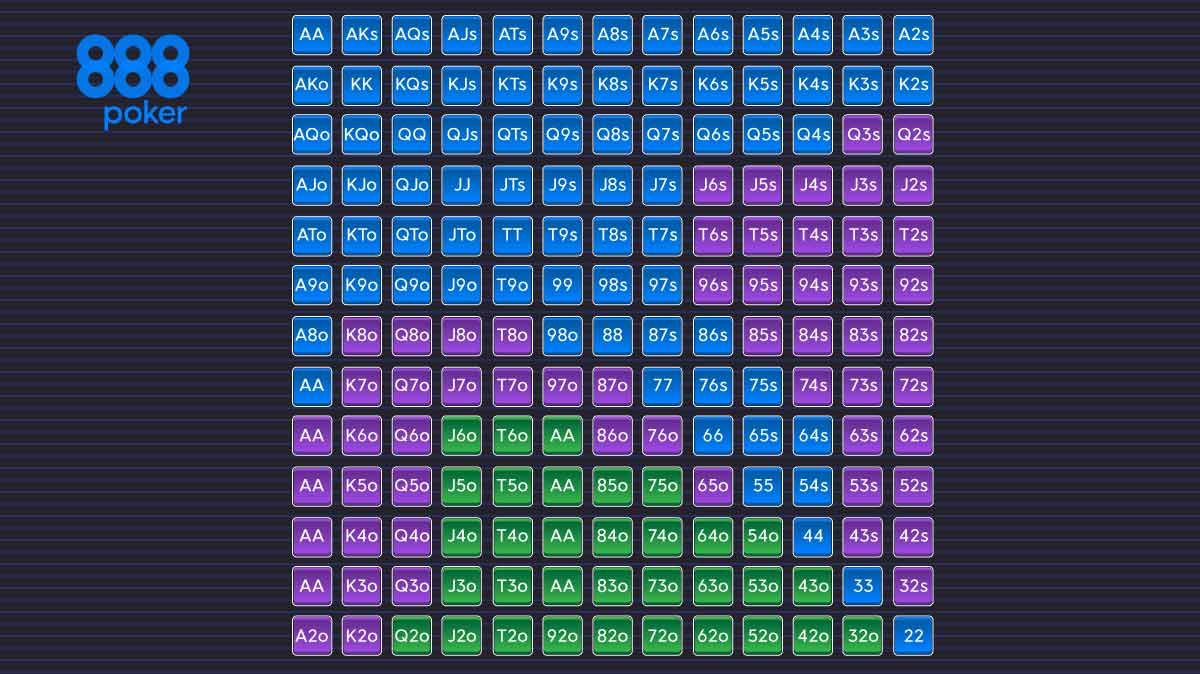
A potential small blind range against a weak big blind opponent:
- Blue: open-raise.
- Purple: limp (complete).
- Green: fold.
Against a competent big blind, the picture changes. When the action folds around to you, raising the small blind generally outperforms completing, so the discount alone isn’t reason enough. The weaker your opponent, the more the complete is worth.
Over Limping Behind Other Limpers
Once two or more players have limped, the maths of raising shifts. A standard isolation raise is roughly three times the big blind plus one extra big blind for every limper, so a field of three limpers turns a routine raise into a large commitment. Plenty of speculative hands aren’t worth that price, and are worth the cheap flop.
Suited connectors and small pairs do well in these pots. They need multiple opponents and a low entry price to pay off, and a multi-way limped pot supplies both. With one limper ahead of you and a strong hand, raise. With a marginal hand and a crowd, coming along for the minimum is defensible.
Key Takeaways
- A limp is a preflop call of the big blind, and it’s only available when nobody has raised ahead of you.
- There are three types: the open limp, the overlimp (limping behind), and the small blind complete.
- Open limping signals weakness, makes your range readable, and invites extra opponents into the pot.
- Raising instead narrows the field, builds the pot, earns the betting lead, balances your range, and keeps your bluffs credible.
- Completing from the small blind is justified against limpers, and against a weak big blind heads-up.
- Over limping is justified with speculative hands when several players have already limped and an isolation raise would be too large.
- Against a strong big blind heads-up, raising the small blind beats completing.
